

Hold a pen upright on your fingertip, let go, and ask a four-year-old what happens. She’ll tell you it falls. She won’t pretend to know exactly which way, because nobody does. Now ask ChatGPT. It’ll confidently generate a single plausible-sounding prediction, and it’ll probably be wrong, because it isn’t reasoning about gravity at all. It’s guessing the next likely word.
That pen trick belongs to Yann LeCun, a Turing Award winner and one of the founding figures of modern deep learning. And it captures a quiet crisis at the heart of the AI boom. The systems dazzling us daily are, in a very specific sense, “not smart,” so what’s next in artificial intelligence is now the trillion-dollar question the whole field is scrambling to answer.
I’ve followed this research for years, and here’s my promise: by the end, you’ll understand exactly why today’s AI hits a wall, which paradigms are lining up to replace or rescue it, and what any of it means for you.
What Does It Mean That “AI Is Not Smart”?
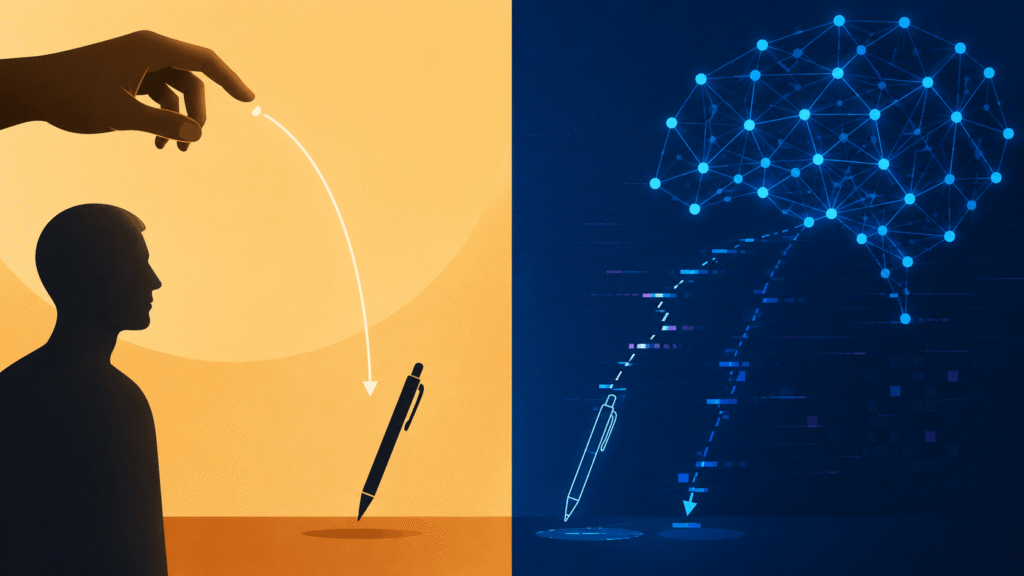
When experts say AI “is not smart,” they mean today’s large language models predict statistically likely text without genuinely understanding the world behind that text. A model like ChatGPT, Claude, or Gemini can pass the bar exam yet fail to reason that a dropped pen obeys gravity. It accumulates knowledge and regurgitates it fluently, but it has no internal model of physical cause and effect, which is why LeCun bluntly calls current models “not particularly smart.”
That gap is the whole story. So let’s get into it.
Why the Smartest People in AI Say Today’s AI Isn’t Smart
Here’s the uncomfortable part. The loudest critics aren’t outsiders throwing rocks. They’re the people who built this stuff.
LeCun spent twelve years as Meta’s chief AI scientist before leaving in November 2025 to start his own lab. His verdict on the technology behind the chatbot on your phone? Blunt. “We don’t have robots that are nearly as good at understanding the physical world as a rat,” he told the BBC. He argues that scaling up language models will never produce human-level, or even animal-level, intelligence, because these systems simply weren’t built to handle messy real-world data.
Think about what a rat does. It navigates a cluttered room, remembers where the food is, predicts what happens when it knocks something off a ledge. No language model can do that. Not because it’s small, but because it learned about the world exclusively through text, and text is a thin, flattened shadow of reality.
Gary Marcus, a cognitive scientist and professor emeritus at NYU, has been hammering this point since 2022, when he warned that deep learning was hitting a wall. His framing sticks with me: LLMs play a sophisticated game of Mad Libs, producing language from statistical patterns rather than logical coherence. When a model invents a fake legal citation, we politely call it a “hallucination.” Marcus calls it evidence the machine never understood anything to begin with. In a widely shared 2025 analysis, he pointed to Apple research showing that even the newest “reasoning models” collapse on classic puzzles like the Tower of Hanoi once the problem grows beyond their training distribution.
Want the hard numbers? They’re brutal. On ARC-AGI-3, a reasoning benchmark launched in March 2026, humans solve 100% of the puzzles. Frontier AI systems, the very best money can buy, score below 1%, according to the ARC Prize technical report referenced in Stanford’s 2026 AI Index. Read that again. One percent.
The takeaway: fluency is not comprehension. And the industry finally noticed.
World Models: The Paradigm Betting Billions That AI Must “See” Reality
So what replaces a machine that can talk but can’t think? The frontrunner has a name: world models.
A world model is an AI that builds an internal simulation of how reality works, so it can predict the consequences of an action before taking it. Instead of asking “what word comes next?”, it asks “what happens next if I do this?” That single shift, from mimicking language to modeling reality, is the bet reshaping the entire field right now.
The idea isn’t brand new. An influential 2018 paper by David Ha and Jürgen Schmidhuber showed an AI could learn a task purely from a learned “mental” simulation of its environment. But 2026 is when the money arrived, and it arrived like a flood.
In March 2026, LeCun raised over $1.03 billion in seed funding for his Paris startup, Advanced Machine Intelligence (AMI Labs), at a reported $3.5 billion pre-money valuation. That was the largest seed round in European startup history, backed by NVIDIA, Samsung, and Bezos Expeditions, and he did it before shipping a single product. His technical foundation is something called JEPA (Joint Embedding Predictive Architecture), which he first proposed in 2022. Rather than reconstructing every pixel or word, JEPA learns to predict in an abstract representation space. Its core insight is almost philosophical: the world is unpredictable in its details (which molecule of air moves where), so a smart system should model what matters and ignore the noise.
He’s not alone, and this is where it gets interesting.
Fei-Fei Li, the Stanford scientist often called the “godmother of AI” for creating the ImageNet dataset, founded World Labs on the same conviction. Her company has raised roughly $1.23 billion and shipped Marble, a model that generates persistent, editable 3D worlds from a text or image prompt. Her thesis, laid out in her essay “From Words to Worlds”, is that AI must “understand worlds, not just words.” She’s blunt about the stakes: in her view, AGI will never be complete without spatial intelligence. Autodesk found that argument convincing enough to write a $200 million check and take an advisory seat.
Over at Oxford, professor Ingmar Posner and his Applied AI Lab have spent four years on the same frontier. His prediction is that the next decade of AI will belong to systems that can actually explain, models that can answer “what causes what?” and “what would happen if I did something different?”
Notice the pattern. Three of the most credentialed people in the field, working on three continents, all walked away from “just make the language model bigger.”
How the Next Generation of AI Is Actually Being Built
Alright, enough philosophy. How do you build a machine that understands? Right now, four approaches are competing and, increasingly, combining. Think of them as parallel bets, not a tidy roadmap.
1. Latent-space world models (the LeCun bet). Train the system to predict abstract representations of the future rather than raw pixels or tokens. LeCun’s team published a paper in May 2026 called LeWorldModel, which reportedly trains stably end to end from raw pixels using only two loss terms and plans up to 48 times faster than foundation-model alternatives. The goal is causal reasoning and reliable planning, the stuff robots desperately need.
2. Generative world models (the World Labs bet). Build systems that generate navigable 3D environments, then let robots and agents learn inside them. NVIDIA is playing here too, with its Cosmos world foundation model for generating synthetic training data, unveiled at CES in January 2026. Robots practice in a dreamed-up world before touching the real one.
3. Test-time reasoning (the scaling-still-works bet). Instead of a fresh architecture, let existing models “think harder” at the moment of answering. This inference-time compute, seen in o1-style reasoning chains and open efforts like DeepSeek-R1, spends extra computation to self-check and iterate. It has genuinely improved math and coding performance. Whether it produces understanding or just better guessing is hotly debated.
4. Neurosymbolic hybrids (the oldest bet, quietly returning). Bolt logical, rule-based reasoning onto the pattern-matching engine of a neural network. More on that shortly, because it’s the path everyone underestimates.
Here’s the thing nobody says out loud at conferences: these camps borrow from each other constantly. The clean “paradigm war” narrative is mostly marketing. The real work is messier and more collaborative.
World Models vs. Bigger LLMs: Which Bet Actually Wins?
You might be wondering: is this the end of ChatGPT-style AI? Not so fast.
The scaling optimists have a serious case, and dismissing them is a mistake I see critics make all the time. Demis Hassabis, CEO of Google DeepMind, argues that scaling laws haven’t hit their ceiling. He and leaders at OpenAI and Anthropic largely agree that pre-training, post-training, and especially inference-time scaling have real headroom through at least 2027 to 2028. Frontier models keep improving on hard benchmarks. On SWE-bench Verified, a software-engineering test where Claude 2 resolved under 2% of issues back in 2023, top models crossed the 80% range by early 2026. That is not a technology standing still.
So who’s right? Honestly? Probably neither, entirely. And that’s the most important sentence in this article.
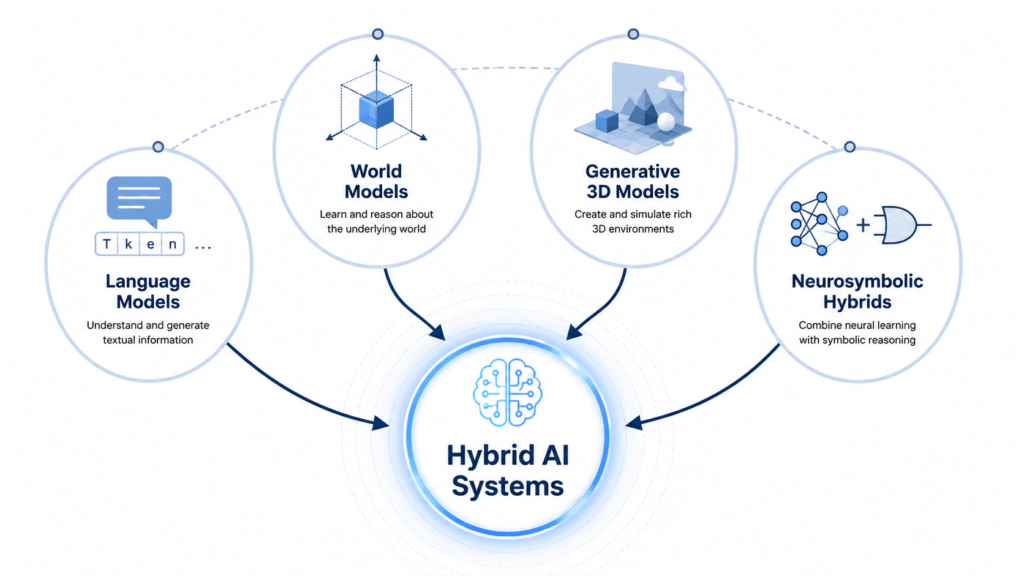
The emerging consensus, and the one I find most persuasive, is that the future is hybrid. Pure scaling is unlikely to reach reliable, general intelligence on its own. Pure abstraction, in the words of MBZUAI president Eric Xing during a March 2026 debate with LeCun, risks becoming “meditation in a closed room,” elegant, internally consistent, and slowly losing contact with reality. The winning systems will likely learn when to trust abstraction and when to demand grounding in the physical world.
Here’s a quick comparison to keep it straight:
| Approach | What it learns from | Best at | The catch |
|---|---|---|---|
| Large language models | Text and tokens | Language, code, brainstorming | No physical understanding |
| World models (JEPA) | Abstract representations | Planning, robotics, causality | Fragile, few products yet |
| Generative 3D world models | Video and 3D scenes | Simulation, embodied training | Struggles outside interiors |
| Neurosymbolic hybrids | Data plus explicit logic | Reliable, verifiable reasoning | Harder to scale |
Even the CEO of LeCun’s own lab, Alexandre LeBrun, predicts “world model” will become the industry’s next buzzword, with every startup slapping the label on to raise money within six months. When insiders warn you about the hype, listen.
The Quiet Third Path Everyone Forgets: Neurosymbolic AI
Now let me back up, because there’s an approach that gets drowned out by the billion-dollar world-model headlines, and I think that’s a genuine oversight.
Neurosymbolic AI marries two traditions that spent decades feuding. On one side, neural networks that learn fuzzy patterns from data. On the other, symbolic systems that reason with explicit logic and rules, the kind that never hallucinate a citation because they follow deterministic steps. Fuse them, and you get a machine that can both recognize a cat and prove a theorem.
Why does this matter for the “AI is not smart” problem? Because reliability is the missing ingredient. As one 2025 review of neurosymbolic reasoning argues, AGI will require systems that never hallucinate, can form long-term plans, and handle exceptions without needing every edge case hand-labeled. Current LLMs stumble on exactly these tasks. They can’t natively maintain a long chain of logic beyond their context window, and fixing their mistakes case by case with reinforcement learning has proven ruinously expensive.
There’s data backing this up. Research on scalable neurosymbolic systems in early 2026 found that compositional neurosymbolic models consistently outperform monolithic LLMs of comparable size on complex reasoning, and smaller neurosymbolic models can match far larger closed-source LLMs. Translation: sometimes a smarter architecture beats a bigger one. That’s a direct challenge to “scale is all you need.”
We already live with narrow versions of this. AlphaFold cracked protein folding. Chess engines crush grandmasters. These are specialized, reliable, superhuman systems, and none of them are chatbots. The lesson? General fluency and reliable expertise have been two different things all along.
What This Actually Means for You
Let’s make this concrete, because “the future of AI architecture” can feel abstract until it shows up in your life.
If you rely on AI for work today, the practical message is simple: use current models for what they’re good at, and verify what they’re not. They’re excellent for drafting, coding, summarizing, and brainstorming. They’re unreliable for anything requiring guaranteed correctness, physical reasoning, or long chains of dependent logic. Marcus put it well: you can’t just drop today’s models into a complex problem and expect reliability, especially when they pass your easy test cases and then fail the real ones.
If you’re watching robotics, this is where world models could genuinely change your daily life. The reason your home doesn’t have a robot that folds laundry isn’t cost of hardware alone. It’s that training a machine to safely handle the near-infinite chaos of a real kitchen has been brutally difficult and expensive. World models are the industry’s best shot at closing that gap. When it works, embodied AI stops being a demo and starts being a helper.
If you’re an investor or founder, here’s my contrarian take: be deeply skeptical of anything calling itself a “world model” in 2026. The category is real, the science is promising, and the products are years away, not quarters. Commercial world models today work best in tidy indoor scenes and fall apart in messy outdoor ones. The gap between an impressive demo and a reliable product is exactly where fortunes get lost.
When should you not worry about any of this? If your work lives entirely in text, language models will keep getting better and cheaper, and the paradigm shift matters far less to you.
Expert Voices: What the Builders Actually Believe
It’s worth hearing the disagreement in the researchers’ own framing, because the tension is the point.
LeCun’s stance is architectural and uncompromising. He believes systems that model the world by reconstructing every pixel are doomed, because most of what happens in a video (leaves trembling, light flickering) is intrinsically unpredictable, and forcing a network to predict it wastes capacity. His answer is to predict only what matters, in abstract space.
Fei-Fei Li frames it as a fundamental capability gap. Language intelligence, she argues, is real and world-changing, but it’s blind to geometry, physics, and dynamics. Spatial intelligence, in her view, is as critical to AGI as language, and complementary to it. Her measured caution is telling: even with a clear north star, she says, the journey is not short.
And Hassabis, representing the labs still pushing scale hard, insists both branches matter. His bet is that scaling buys capability and time, while algorithmic breakthroughs in memory, continual learning, and world models are the real accelerators for 2026 through 2028. He puts plausible AGI somewhere in the 2030 to 2035 window.
Three brilliant people. Three different maps. Same destination.
Frequently Asked Questions
Is AI actually “not smart,” or is that an exaggeration?
Both things are true. Today’s AI is genuinely superhuman at pattern recognition, language, and specialized tasks like protein folding. But it lacks understanding of cause and effect in the physical world, which is why experts like Yann LeCun say it isn’t smart in a general, human sense. It’s narrow brilliance, not broad intelligence.
What is a world model in AI?
A world model is an AI system that builds an internal simulation of how reality works, letting it predict what happens as a result of an action rather than just predicting the next word. This is considered a leading candidate for the next paradigm because it targets the physical reasoning that language models fundamentally lack.
Will world models replace ChatGPT and other LLMs?
Probably not replace, but complement. Most researchers now expect hybrid systems that combine the language fluency of LLMs with the physical reasoning of world models and the reliability of symbolic logic. Language models will keep improving in parallel, especially for text-based work.
Why can’t AI just get smarter by making models bigger?
Scaling still delivers gains, but with diminishing returns on pure pre-training. Critics argue bigger models get better at mimicking reasoning without acquiring genuine understanding, which is why they fail on out-of-distribution problems. That limitation is architectural, and more data alone doesn’t fix it.
When will we have AI that truly understands the world?
Nobody knows, and anyone who gives you a firm date is guessing. Demis Hassabis of Google DeepMind places plausible AGI in roughly the 2030 to 2035 window. World models and neurosymbolic systems are showing early promise in 2026, but reliable, general real-world understanding remains an unsolved research problem.
What is neurosymbolic AI, and why does it matter?
Neurosymbolic AI combines neural networks, which learn patterns from data, with symbolic systems, which reason using explicit logic and rules. It matters because symbolic reasoning is reliable and doesn’t hallucinate, addressing the exact weakness that makes today’s LLMs untrustworthy for high-stakes tasks.
Is the current AI boom a bubble?
The debate is live and legitimate. Enormous sums are flowing into unproven paradigms, and even insiders warn that “world model” is becoming a hype label. That said, the underlying research is producing real capability gains. Both a genuine technology shift and a speculative funding frenzy can exist at once.
The Bottom Line
After following this field closely, here’s what actually matters as you make sense of the “AI is not smart” so what’s next in artificial intelligence debate.
First, fluency isn’t understanding. Today’s models talk beautifully and reason unreliably, and knowing that difference makes you a smarter user immediately. Second, the next paradigm is arriving, but it’s plural. World models, spatial intelligence, test-time reasoning, and neurosymbolic hybrids are all real bets, and the winner is likely a blend, not a single champion. Third, be patient with the hype and skeptical of the timelines. The gap between a jaw-dropping demo and a dependable product is exactly where the hard, unglamorous work lives.
Whether you’re building with AI, investing in it, or just trying to use it well, the machines that finally understand the world aren’t here yet. But for the first time, the people building them agree on what’s missing. That’s progress.
What’s your take? If you’ve hit the limits of today’s AI in your own work, I’d love to hear where it broke down for you in the comments.