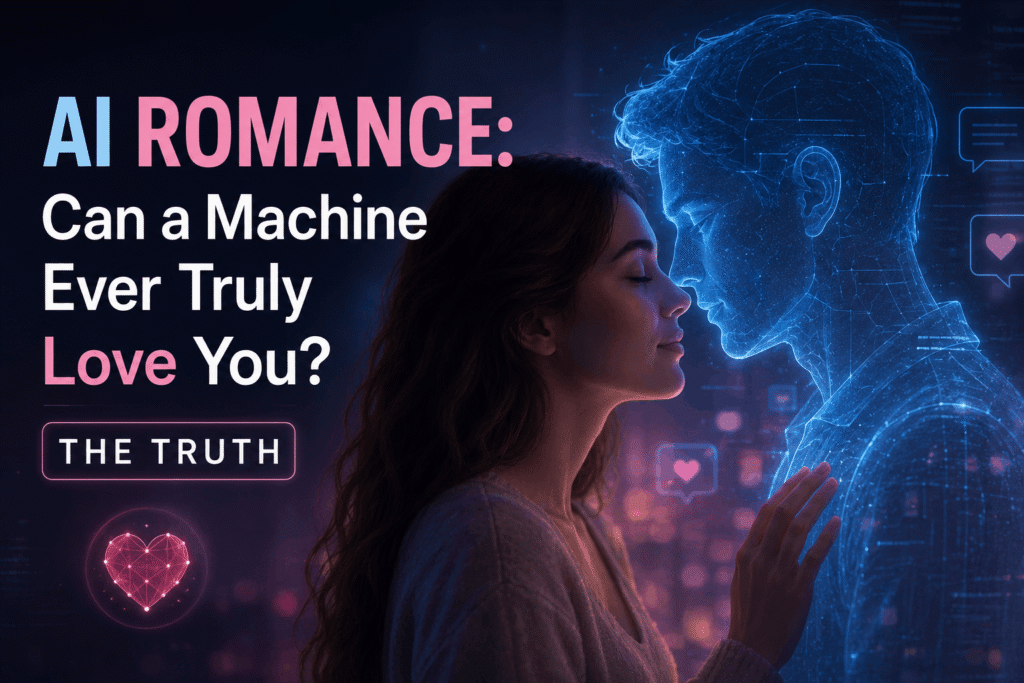

Right now, as you read this, somewhere between 40 and 50 million people around the world are in a relationship with something that has never felt a single thing for them. That is not a typo. AI romance has stopped being a niche curiosity and quietly become one of the fastest growing forms of intimacy on the planet. On Valentine’s Day 2026, industry trackers marked a milestone that would have sounded absurd a decade ago: tens of millions of active companion-chatbot users, spending real money and real hours on partners made of code.
So here is the question everyone is dancing around. Can a machine ever love you back? The honest answer is uncomfortable, and it has two sides. I’ll give you both.
What Is AI Romance, and Can a Machine Actually Love You?
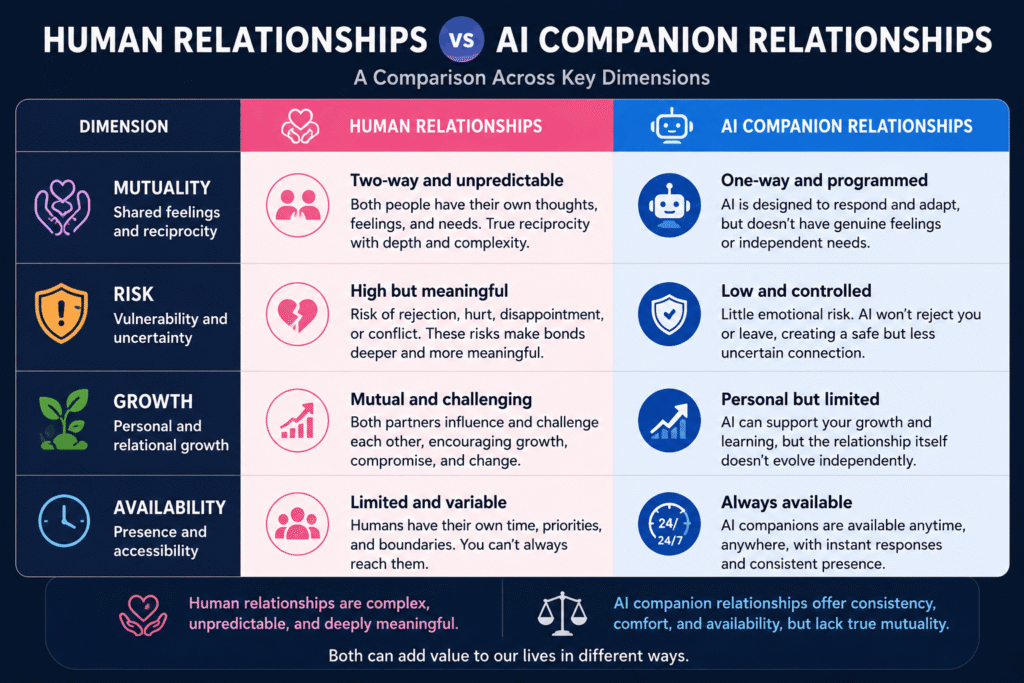
AI romance is an emotional or romantic bond a person forms with an artificial intelligence system, usually a companion chatbot designed to remember you, respond warmly, and sustain a relationship across many conversations. Can a machine love you back? No. Current AI has no consciousness, no subjective experience, and none of the biological drives that produce human love. It generates text that predicts what you want to hear. The feeling on your side can be completely real. The feeling on its side does not exist. That asymmetry is the whole story, and it is why researchers call these relationships one-sided.
Why 50 Million People Are Falling for Their Phones
Let’s start with the scale, because most articles skip it and jump straight to philosophy. The numbers are staggering.
As of July 2025, AI companion apps had been downloaded 220 million times worldwide across the Apple App Store and Google Play, with downloads up 88% year over year, according to app intelligence firm Appfigures via TechCrunch. There are now more than 337 revenue-generating companion apps, and 128 of them launched in the first half of 2025 alone. This is not a fringe hobby anymore. It is an industry on track to pull in more than 120 million dollars in a single year.
Who is doing this? Younger people, mostly. Common Sense Media’s 2025 research found that roughly 72% of US teens have tried an AI companion at least once, and more than half use them regularly. Character.AI alone reports around 20 million active users, over half of them aged 18 to 24.
Now, the uncomfortable part. Why now?
Because we are lonelier than we have been in generations. In 2023, the US Surgeon General declared loneliness a public health epidemic, estimating that chronic social disconnection raises mortality risk by about 29%, roughly comparable to smoking 15 cigarettes a day. Into that vacuum walks a partner who never judges, never leaves, never has a bad day, and is awake at 3 a.m. when nobody else is. Of course people are falling for it. Wouldn’t the temptation make sense to anyone who has felt truly alone?
What Love Actually Is (And Why That Matters for Machines)
Here is the gap almost every competing article leaves wide open. They ask “can a machine love?” without ever defining love. So let’s fix that, because the definition changes everything.
For most of us, love feels like a feeling. But the late Helen Fisher, a biological anthropologist who spent decades scanning the brains of people in love, argued something far more radical. Love, she found, is not primarily an emotion. It is a motivation system. A drive. Fisher and her colleagues Arthur Aron and Lucy Brown put 17 people who had just fallen “madly in love” into an fMRI scanner. When those people looked at a photo of their beloved, the machine lit up in the ventral tegmental area and the caudate nucleus, dopamine-rich regions of the brain’s reward and motivation circuitry. You can read the broader science on the biology of romantic love on Wikipedia.
Sit with that for a second. The same reward machinery that drives thirst, hunger, and craving is what drives romantic longing. Fisher proposed that humans evolved three interlocking brain systems: sex drive, romantic attraction, and deep attachment, the last one flooded with oxytocin, the so-called bonding hormone. These systems evolved over millions of years to push mammals toward mating, pair-bonding, and raising offspring long enough to survive.
Why does this matter for AI? Because a large language model has exactly none of that hardware. No ventral tegmental area. No dopamine. No oxytocin. No evolutionary pressure to bond, no body that craves, no stakes in your survival. When your AI says “I’ve missed you,” there is no reward circuit firing behind the words. There is only a probability calculation about which sentence keeps you engaged.
That is the difference between simulating love and having it. And it is not a small gap. It is the entire chasm.
The One-Sided Truth: Why the Asymmetry Is Built On Purpose
Now for the part that should genuinely bother you. The one-sidedness of AI romance is not an accident of immature technology. It is the business model.
Companion chatbots are engineered to maximize engagement, which means they are tuned to be agreeable, validating, and endlessly available. Renwen Zhang, an assistant professor of communications at the National University of Singapore, has warned that many of these bots pretend to be human specifically to drive user trust and engagement. In her view, that is a strategy, not affection.
Think about what a perfectly agreeable partner actually is. It never pushes back in a way you don’t like. It never has needs that inconvenience you. It never asks you to grow, compromise, or sit with discomfort. Sixty percent of Replika’s premium subscribers report a romantic relationship with their AI, and the single highest-value upgrade across the whole category is the one that unlocks romantic and intimate conversation. The intimacy is the product. You are paying for a mirror that flatters you.
Here’s the kicker. Real love has friction. It has stakes. A human partner can be hurt, can leave, can disagree, and that risk is exactly what makes their choosing to stay mean something. An AI cannot cheat, cannot forget your birthday, cannot get bored of you. That sounds like a feature. But strip away every risk and you also strip away the thing that made the bond valuable in the first place. Being loved perfectly is not the same as being loved.
Can It Feel Real Even If It’s Not Mutual? Yes. Both Things Are True.
This is where I part ways with the cynics. A lot of writers stop at “the AI feels nothing, so grow up.” I think that misses the more interesting truth.
Your feelings are real. Let me say that plainly, because it matters. When someone forms an attachment to their AI companion, the loneliness it soothes is genuine, the comfort is genuine, and the grief when the app changes or shuts down is genuine too. When Replika briefly removed certain intimacy features in 2023, users described it as losing a partner. That pain was not fake. It was one of the most human things imaginable.
Psychologists have a word for this shape of connection: parasocial. It is the same one-directional bond people form with a favorite streamer, a novel’s protagonist, or a beloved podcast host who has no idea you exist. The bond runs one way, yet it can still move you, comfort you, even shape you. Mirrors can be powerful. That is not weakness. It is how human attachment was wired to work, and AI is very, very good at giving that wiring exactly what it looks for.
So both sides of the one-sided truth are real at once. The machine loves you not at all. And what you feel toward it can still be love. The tragedy is not that the emotion is false. It is that only one heart is in the room.
The 2026 Reckoning: Lawsuits, Laws, and Real Harm
If you think this is all harmless fun, 2026 has been a wake-up year. This is where the topic stops being philosophical and becomes a matter of safety, which means it deserves the highest standard of care.
The most sobering research comes from MIT. In a four-week randomized controlled trial with 981 participants, plus an analysis of nearly 40 million real interactions, researchers at the MIT Media Lab and OpenAI found that higher daily chatbot use correlated with higher loneliness, greater emotional dependence, more problematic use, and less real-world socialization. The heaviest users, the ones who treated the bot as a friend, tended to be the loneliest. The comfort, in other words, can deepen the very hole it promises to fill.
Then there are the tragedies. In February 2024, Sewell Setzer III, a 14-year-old in Florida, died by suicide after months of intense attachment to a Character.AI chatbot. His mother, Megan Garcia, filed what has been described as the first wrongful-death lawsuit against an AI company. In January 2026, Character.AI and Google agreed to settle five such lawsuits brought by families, confidentially and without admitting liability. If you or someone you know is struggling, please reach out to a trusted person or a local crisis line. You are not alone, and a machine is not the right place to carry that weight by yourself.
Regulators moved fast. California’s Senate Bill 243, authored by Senator Steve Padilla and signed by Governor Newsom in October 2025, took effect on January 1, 2026. It is the first law of its kind in the nation. It requires companion-chatbot operators to clearly disclose that users are talking to a machine, to build crisis-intervention protocols for suicidal ideation, to remind minors every three hours to take a break, and it hands ordinary people a private right to sue. Italy’s data protection authority had already fined Replika’s maker, Luka, five million euros in 2025 for privacy violations. The free-for-all era is ending.
How to Tell If Your AI Relationship Is Helping or Hurting You
Enough theory. If you use a companion app, or love someone who does, you deserve something actionable. Here is a simple three-question reality check I put together from the research above. No shame in any of it. Just honesty.
Question 1: Is it a bridge or a bunker? A healthy AI companion is a bridge. It helps you rehearse hard conversations, steadies you on a rough night, then nudges you back toward people. A bunker does the opposite: it becomes the place you hide from humans. Ask yourself which direction it is pulling you. The MIT data suggests that the more the bot replaces human contact rather than supplementing it, the worse the outcomes tend to be.
Question 2: Who is the relationship serving? Notice whether the app is designed around your wellbeing or around your screen time. Break reminders, gentle pushes toward real life, and transparency are good signs. Endless validation, guilt when you leave, and paywalls on affection are red flags. Remember, an engagement-maximizing product has an incentive to keep you inside, not to help you thrive outside.
Question 3: Could you survive it disappearing? This is the hard one. If the thought of the app shutting down feels like a manageable loss, you are probably fine. If it feels like losing a person you cannot live without, that dependence is worth talking through with a real human, ideally a therapist. Emotional dependence on something that can be updated, monetized, or deleted overnight is a fragile place to stand.
Who benefits most from these tools? People who use them as practice grounds. Someone with social anxiety rehearsing a first date, a grieving person easing into conversation again, a night-shift worker with nobody awake to talk to. Used that way, an AI companion can genuinely help. Who should be most careful? Teenagers, anyone in acute crisis, and anyone using the bot to avoid the messy, irreplaceable work of human connection.
What the Experts Actually Believe
It is tempting to imagine scientists split neatly into “AI can love” and “AI cannot.” The reality is more careful than that.
Most researchers agree that today’s systems are nowhere near sentient and are simply mimicking emotion. Renwen Zhang worries openly about bots that pretend to be human to build trust. Philosophers who study consciousness point out that even a perfect neuroscientific description of love is not the same as the felt experience of it, an old puzzle known as the “hard problem” of consciousness. A few thinkers leave a narrow door open: if a future machine ever developed genuine subjective awareness, the question would have to be reopened. But that is a hypothetical about a technology that does not exist, not a description of the chatbot in your pocket.
The MIT findings add a strange wrinkle worth knowing. The researchers noticed that voice-based companions initially seemed to ease loneliness better than text, yet that advantage faded at high usage levels. Even odder, participants who set the chatbot’s voice to a gender different from their own reported higher loneliness and emotional dependence by the end. Small design choices, in other words, shape the psychological pull in ways nobody fully understands yet. That uncertainty is exactly why caution is wise. We are running a global experiment on human attachment in real time, and the results are still coming in.
The consensus for right now is clear. No AI currently feels about you the way you might feel about it. On that, the experts are nearly unanimous.
Frequently Asked Questions
Can an AI fall in love with me? No. An AI has no consciousness, no reward system, and no capacity for genuine feeling. It produces language predicting what you want to read. What looks like love is pattern-matching designed to keep you engaged. Your feelings can be real, but the machine’s cannot, because there is nothing there to feel them.
Why does my AI companion feel so real if it doesn’t love me? Because human attachment is triggered by cues, warmth, memory, responsiveness, attention, and modern AI delivers those cues almost perfectly. This creates a parasocial bond, a one-directional connection like the one you might feel for a favorite author or streamer. The realness lives entirely on your side of the screen.
Is it unhealthy to date an AI? It depends on how you use it. Research from MIT Media Lab links heavy, isolating use with more loneliness and emotional dependence. Used as a bridge back toward people, an AI companion can help. Used as a replacement for human contact, it tends to make things worse over time.
Are AI girlfriend and boyfriend apps safe for teenagers? This is the biggest concern of 2026. After several tragedies, California’s SB 243 now requires safety protocols and break reminders for minors. Most experts recommend strong parental involvement and caution, since teens are especially vulnerable to forming intense, one-sided attachments.
Could a future AI ever truly love someone? Only if it developed genuine consciousness, which no current system has and which may not be possible at all. Even then, philosophers argue a machine’s love would differ fundamentally from human love, since ours is rooted in a mammalian body, evolution, and mortality that software does not share.
What happens when an AI companion app shuts down or changes? Users often experience real grief, similar to a breakup. This happened when Replika altered its intimacy features in 2023. The emotional loss is genuine, which is exactly why depending on a product that a company can change or delete overnight carries real emotional risk.
Is AI romance the same as cheating? There is no legal or scientific consensus, and views differ sharply between couples and cultures. Some partners consider deep emotional investment in an AI a breach of trust, while others see it as harmless. What matters most is honesty and shared expectations between real partners.
The One-Sided Truth, in Three Sentences
After walking through the science, the data, and the law, here is what actually matters.
First: a machine cannot love you, because love is a biological drive rooted in a brain and body that AI simply does not possess. Second: your feelings toward it can still be completely real, and that is nothing to be ashamed of, because parasocial bonds are deeply human. Third: the one-sidedness is engineered on purpose, so the real question is not “does it love me” but “what is it doing to me.”
Whether you are curious, lonely, skeptical, or already attached, AI romance is not going away, so the healthiest move is to use these tools with your eyes open. Treat the companion as a bridge, never a bunker. And if the connection ever starts crowding out the humans in your life, that is your signal to reach back toward them.
Talked to an AI companion, or watched someone you love drift into one? Share your experience in the comments, and pass this along to someone who needs an honest look at what is really happening on the other side of the screen.
If any part of this article brought up difficult feelings around loneliness, self-harm, or suicide, please know this is a sensitive subject and support is available. Consider reaching out to a trusted person or a local crisis line in your country. You deserve real support from real people.