
Meta just did something it has never done before. On July 9, 2026, the company released Muse Spark 1.1 and, for the first time in its history, started charging developers to use one of its own AI models. That alone would be big news. But the launch landed 48 hours after Meta’s new image model triggered a privacy firestorm over public Instagram photos, and the two stories are now impossible to separate.
So here’s what this article does. It walks you through what Muse Spark actually is, what the new Meta Model API costs, how the model stacks up against GPT-5.5 and Claude, and, crucially, what the Instagram data controversy is really about. Including the part most coverage gets wrong. Stick around for that one, because the internet is currently blaming the wrong model.
What Is Muse Spark? A Plain-English Definition
Muse Spark is a multimodal AI reasoning model built by Meta Superintelligence Labs for agentic tasks, meaning work that requires planning, using tools, and taking actions across apps rather than just answering questions. Muse Spark 1.1, released July 9, 2026, features a 1 million token context window, accepts text, images, video, and documents as input, and is available free to consumers in the Meta AI app and to developers through the new paid Meta Model API.
That’s the snippet version. Now the story behind it.
The original Muse Spark debuted in April 2026 as Meta’s re-entry into the frontier model race after a rough stretch for its Llama family. It came out of Meta Superintelligence Labs, the AI unit Mark Zuckerberg reorganized under Alexandr Wang, Meta’s first-ever chief AI officer. Wang joined after Meta spent $14.3 billion in 2025 for a 49 percent non-voting stake in Scale AI, the data company he founded.
Three months later, version 1.1 arrived. Fast, by frontier-lab standards. And it arrived in a busy week: Meta shipped Muse Image, its first image-generation model from the new lab, on July 7, previewed Muse Video the same day, then dropped Spark 1.1 and the developer API on July 9.
Why the sprint? Meta has poured tens of billions into AI infrastructure, chips, and an aggressive hiring spree. Shipped products are how you justify that spend. Muse Spark is now expected to replace the Llama models powering chatbots across WhatsApp, Instagram, Facebook, and Meta’s Ray-Ban smart glasses, which puts it in front of billions of people almost overnight.
What’s Actually New in Muse Spark 1.1
The quick answer: Muse Spark 1.1 brings major gains in tool use, computer use, coding, and multimodal understanding compared with the April model, plus a self-managed 1 million token context window and adjustable reasoning depth. Meta positions it as an agent orchestrator first and a coding model second.
Let’s unpack the pieces that matter.
A million tokens, actively managed
The context window is 1,000,000 tokens (the API docs list 1,048,576 to be precise). That’s enough to hold an entire mid-sized codebase, hours of meeting transcripts, or a stack of PDFs in a single session. The more interesting part is what Meta calls active context management: the model compacts its own memory as it works, dropping stale detail while keeping the steps a long-running workflow needs later. Anyone who has watched an AI agent forget its own plan halfway through a task knows why that matters.
Adjustable reasoning effort
Spark 1.1 is a reasoning model. It thinks before it answers, and those thinking tokens are billed as output. A reasoning_effort parameter runs from minimal to xhigh, so developers match depth to the task. Quick classification job? Minimal. Multi-hour code migration? Crank it up. You pay for what you use, which is a sensible design and also a quiet reminder that reasoning tokens are where your bill grows.
Multi-agent orchestration
This is the headline capability. According to Meta’s launch announcement, Spark 1.1 is trained to run multi-agent systems: as the main agent it gathers context, makes a plan, and delegates execution to parallel subagents; as a subagent it sticks to its job and escalates when it hits a wall. It also zero-shot generalizes to new tools, MCP servers, and custom skills, meaning it can pick up tools it has never seen without special training.
Computer use that knows when to script
Rather than clicking through every desktop step one at a time, the model decides when to write a script (faster for repetitive work) and when to click directly (simpler for one-off actions). Meta’s demo has it organizing a dinner party across multiple apps and adjusting the food order when new information shows up mid-task. Small thing, big deal. Handling mid-task changes without human intervention is where most computer-use agents still faceplant.
Coding, with an honest asterisk
Spark 1.1 can diagnose bugs in large codebases, implement features in enterprise systems, and run big migrations. One demo shows it building a chat web app, taking automated screenshots to spot visual failures, tracing them back to the code, and validating its own fixes. Impressive. But hold that thought, because the benchmark story is more nuanced than the marketing, and we’ll get to it in the comparison section.
Multimodal perception plus action
The model reads images, video, audio, and documents in one call, and can act on what it sees. Meta’s Facebook Marketplace demo is the clearest example: you shoot a smartphone video of an item, and Spark 1.1 extracts the best frames, reasons about the product, then operates a browser to publish the listing for you. Perception and action in the same loop. That’s the “agentic” pitch in one demo.
The Meta Model API: Pricing, Access, and How to Start
Here’s the structural shift hiding inside the product launch. Meta built its AI reputation on open-source Llama models you could download and run yourself. Muse Spark 1.1 is the opposite: proprietary, closed-weight, hosted, and metered per token. Meta is now in the same paid API business as OpenAI and Anthropic, and it’s competing the way Meta always competes. On price.
What it costs:
| Item | Price |
|---|---|
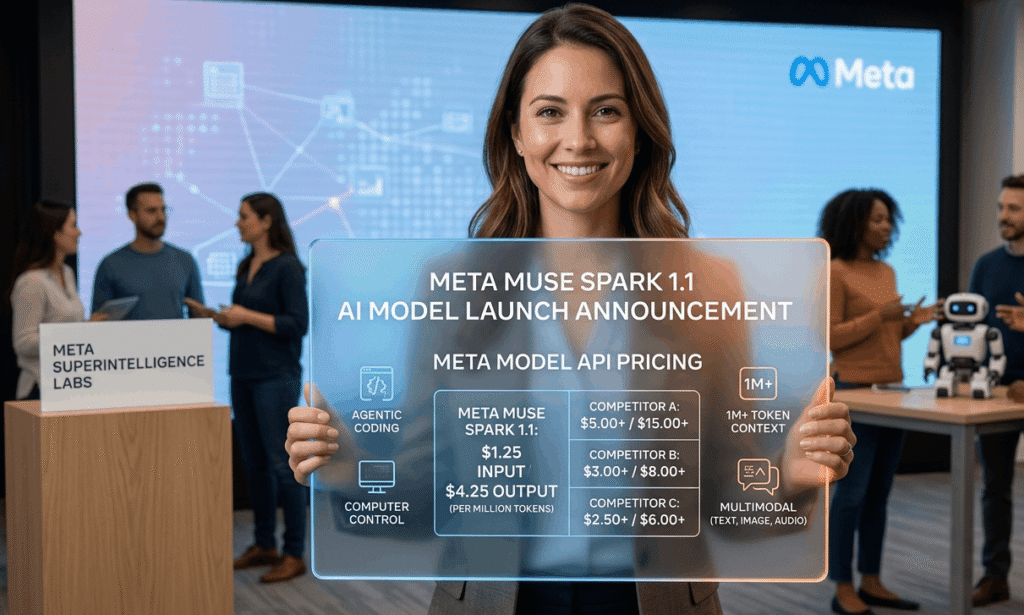
| Input tokens | $1.25 per million |
| Output tokens (includes reasoning tokens) | $4.25 per million |
| New account credit | $20 free |
| Consumer access (Meta AI app, meta.ai) | Free, in “Thinking” mode |
For context, that output price sits below Anthropic’s Claude Sonnet tier and dramatically below flagship models from any lab, while landing above true budget options like GPT-5 mini and Claude Haiku. Bloomberg’s launch coverage framed Zuckerberg’s strategy bluntly: in a crowded market, Meta wants to win on price. Coming from a company with a market cap around $1.53 trillion and advertising money to burn, that’s a credible threat to labs that need API revenue to survive.
Who can access it: The public preview is US-only for now, with no EU access. Given Meta’s long-running friction with European regulators over AI training data, the omission reads as deliberate caution rather than oversight.
How developers get started: The friction is deliberately low. The API speaks both the OpenAI SDK format (Chat Completions and Responses) and the Anthropic Messages format. In practice, migrating an existing agent is a base URL and key change:
from openai import OpenAI

client = OpenAI(
    base_url="https://api.meta.ai/v1",
    api_key=os.environ["MODEL_API_KEY"],
)

response = client.chat.completions.create(
    model="muse-spark-1.1",
    messages=[{"role": "user", "content": "Hello, world!"}],
)
That compatibility choice is strategic. Switching costs between model providers are already low, and Meta just made them nearly zero. Add built-in web search grounding (add a web_search tool and get cited, real-time answers with no retrieval stack to build), a Files API, prompt caching, structured output, and parallel tool calling, and the pitch to developers is simple: point your existing agent here and see if the bill shrinks.
Muse Spark 1.1 vs GPT-5.5 and Claude: What the Benchmarks Really Say
Quick answer first: Muse Spark 1.1 leads on tool-use and agent-orchestration benchmarks but trails Claude Opus 4.8 and GPT-5.5 on pure coding accuracy. It’s an orchestration model at a budget price, not a leaderboard champion, and Meta’s own launch table shows this if you read it carefully.
Now the honest breakdown, because this is where most launch-day coverage went soft.
On Meta’s published comparison table, Spark 1.1 tops the professional and scaled tool-use rows (benchmarks like JobBench and MCP Atlas) and tool-augmented reasoning. Those measure exactly what agents do in production: calling APIs, coordinating tools, completing multi-step jobs. On pure coding accuracy benchmarks like SWE-Bench Pro, DeepSWE, and Terminal-Bench, it places third behind Opus 4.8 and GPT-5.5. Same story on multimodal scores.
Two caveats deserve more attention than they got.
First, Meta chose the benchmark set and ran the evaluation harness itself. Rivals were shown in their strongest modes, which is fair, but self-reported launch tables are marketing documents until independent replication lands. Meta has faced skepticism here before: after allegations in April 2025 that a prior model was tuned on test sets, a former Meta AI executive publicly denied it, saying the company “would never do that.” Fair or not, that history means developers will verify these numbers on their own repositories before believing them. And they should.
Second, the value question isn’t “is it the best model?” It’s “is it the best model per dollar for agent workloads?” Early partners think the answer might be yes. Replit CEO Amjad Masad praised the combination of million-token context, full multimodal support, built-in cited search, and top-tier frontend coding in one OpenAI-compatible package. Cline CEO Saoud Rizwan was more direct: strong tool use “at a price point that makes it viable to run real coding workloads at scale.” That combination, he noted, is rare.
My read? If your workload is a long-running agent juggling many tools, Spark 1.1 is genuinely worth benchmarking against your current stack this week, with $20 of free credits making the test nearly free. If your workload is maximum-accuracy code generation, the incumbents still win, and Meta’s own table quietly admits it.
The Instagram Data Controversy, Explained (And What Everyone Gets Wrong)
Here’s the part you probably came for, and here’s the correction most social media posts need: the privacy controversy is about Muse Image, the image-generation model Meta launched on July 7, not about Muse Spark itself. The two share the Muse brand, launched in the same week, and come from the same lab, so the outrage bled across the whole family. But the mechanics matter, so let’s get them right.
What actually happened
Muse Image, integrated into the Meta AI app and Instagram, lets users generate and edit AI images. The controversial feature: users can pull photos from public Instagram accounts into AI generations, in some cases by simply tagging a username in the prompt. Meta’s own announcement says the model “draws on Instagram for social context.”
The problem is consent. The capability is on by default for public accounts. As Fortune reported, Meta’s decision to let users apply AI generation and editing effects to photos other people had posted publicly, without requiring any explicit permission, sparked outrage from Instagram users. Reddit threads filled with people who had no idea their photos were fair game until they saw the setting.
Why experts are worried
Prachir Singh, senior analyst at Counterpoint Research, laid out the core issue: the feature lets users type someone’s Instagram username into a prompt and generate fake pictures of that person from their public photos, no permission asked, with the feature enabled automatically unless the account owner digs into settings and turns it off. His broader warning was blunter: handing everyday deepfake capability to billions of users makes it harder to trust that any photo is real, and easier for people to be harassed or impersonated online.
Prabhu Ram, Vice President of the Industry Research Group at CyberMedia Research, framed the deeper shift. Until now, a public Instagram profile meant visibility and discoverability. With this feature, it also becomes source material for AI content built on your likeness. The risk moves from “being seen online” to “being repurposed without clear consent or control.” That’s a redefinition of what “public” means, made unilaterally, for a couple of billion people.
There’s also a liability wrinkle Singh flagged that businesses should not skip: if a company uses one of these AI-generated images in an ad and it accidentally includes someone’s recognizable face, the business, not Meta, likely absorbs the lawsuit.
What Meta says in its defense
Meta points to a few mitigations. Muse Image outputs carry a “Content Seal,” an invisible watermark that survives cropping, compression, resizing, and screenshots, and Meta is previewing a public detection tool so anyone can check whether an image was made with Meta AI. The feature only touches public accounts, and opt-out controls exist. Whether opt-out-by-default is an acceptable consent model for people’s faces is the entire debate, and regulators in multiple countries have historically answered no to similar designs.
Why it shadows Muse Spark anyway
Even though Spark 1.1 is a text-and-reasoning model with a completely different function, the controversy raises a fair question that applies to the whole Muse family: what exactly did these models train on, and how much of it came from Meta’s own platforms? Meta has not published a detailed model card for Spark 1.1, and independent outlets noted the documentation is sparse on training data provenance. As AI Chat Daily put it in its launch analysis, the Instagram content controversy puts every subsequent Muse launch under closer scrutiny on exactly this question. That scrutiny is healthy. Meta earned it.
How to Opt Out: Protecting Your Instagram Photos From Muse
If you have a public Instagram account and this bothers you, here’s the fix, based on the steps documented by The National’s coverage of the backlash:
- Open Instagram and tap the settings icon in the upper-right corner.
- Scroll down and select “Sharing and reuse.”
- Turn off the option that allows “people to create with and reuse your content.”
- Some users also see a separate toggle for letting “people use your content on Instagram and with AI features on Meta.” Turn that off too if it appears.
- For audio creators: there’s an additional toggle to block others from creating with and reusing your original audio on Meta AI.
The nuclear option is switching your account to private, which blocks the feature entirely but also kills your reach. For creators who depend on public visibility, that’s not a real choice, which is precisely why critics call the opt-out design coercive.
One more honest note: settings interfaces change, and Meta has been iterating on these controls in real time as the backlash unfolds. If the menu looks different by the time you read this, search “sharing and reuse” inside Instagram’s settings and work from there.
Safety Evaluations: What Meta Disclosed
Credit where due: Meta published safety documentation alongside this launch, evaluating Spark 1.1 under its Advanced AI Scaling Framework across three frontier risk categories: Chemical and Biological, Cybersecurity, and Loss of Control.
The detail worth knowing, surfaced in Meta’s evaluation report and covered by TestingCatalog: the unmitigated version of Muse Spark 1.1 reached a high-risk threshold in the chemical and biological domain and in cybersecurity. Meta then applied multi-layered safeguards and assessed the residual risk as moderate or lower before shipping. The company also reports lower jailbreak success rates than the original Spark on StrongREJECT v2, lower prompt-injection success on AgentDojo, reduced hallucination, and reduced sycophancy.
Two ways to read that. Charitable: Meta ran serious pre-deployment testing, found dangerous raw capability, mitigated it, and told us. Skeptical: a model that hits high-risk thresholds unmitigated is now available to any US developer with a credit card, and the safeguards are all that stands between the two states. Both readings are true at once. What’s genuinely notable is that Meta, historically the open-weights lab, is now publishing frontier-risk evaluations that look a lot like Anthropic’s and OpenAI’s. Closed models come with closed-model responsibilities, and Meta seems to know it.
Who Should Use Muse Spark 1.1 (And Who Shouldn’t)
Strong fit:
- Agent builders running multi-tool, multi-step workflows. The tool-use benchmark leadership, MCP support, and orchestration training target you specifically.
- Cost-sensitive teams with heavy token volume. At $1.25/$4.25 per million tokens with a 1M context window, long-context agent workloads that are painful to afford elsewhere become viable.
- Teams already on OpenAI or Anthropic SDKs who want a near-zero-cost experiment. Change the base URL, run your eval suite, compare the bill.
- Multimodal automation projects: anything where the model must watch, read, and then act, like the Marketplace listing demo.
Poor fit:
- Maximum-accuracy coding. If SWE-Bench-style correctness is your whole game, Opus 4.8 and GPT-5.5 still lead, per Meta’s own table.
- Anyone needing local deployment or fine-tuning. There are no open weights. If that’s a requirement, the Llama line or open-weight alternatives remain your lane.
- EU-based teams. No access in the preview, no announced timeline.
- Regulated industries needing deep documentation. The model card is thin, training data provenance is undisclosed, and independent benchmarks don’t exist yet. If your compliance team asks hard questions, you won’t have answers this week.
Frequently Asked Questions
What is Muse Spark by Meta? Muse Spark is a multimodal AI reasoning model from Meta Superintelligence Labs, built for agentic tasks like tool use, computer use, and coding. Version 1.1, released July 9, 2026, has a 1 million token context window and is Meta’s first model offered through a paid developer API.
Is Muse Spark free to use? For consumers, yes. It runs free in “Thinking” mode in the Meta AI app and on meta.ai, with a Meta login. Developers pay through the Meta Model API: $1.25 per million input tokens and $4.25 per million output tokens, with $20 in free credits for new accounts.
Does Muse Spark use my Instagram photos? The photo controversy involves Muse Image, Meta’s image model launched the same week, which can pull from public Instagram accounts by default. Spark itself is a reasoning model, though Meta hasn’t fully detailed what data trained the Muse family, which is why scrutiny continues.
How do I stop Meta AI from using my Instagram content? Open Instagram settings, find “Sharing and reuse,” and turn off the option allowing people to create with and reuse your content. Disable any related AI-features toggle you see. Making your account private also blocks it, at the cost of reach.
Is Muse Spark better than ChatGPT or Claude? It depends on the job. Meta’s benchmarks show Spark 1.1 leading on tool-use and agent-orchestration tests while trailing GPT-5.5 and Claude Opus 4.8 on pure coding accuracy. Its real edge is price: it undercuts comparable models significantly for agent workloads.
Can developers outside the US use the Meta Model API? Not yet. The public preview is US-only, with no EU access and no announced expansion timeline. European regulatory friction over AI training data is the widely assumed reason for the cautious rollout.
Why is Meta charging for AI now after giving Llama away free? Meta pivoted after investing $14.3 billion in Scale AI and reorganizing under chief AI officer Alexandr Wang. Muse Spark is closed-weight and monetized because Meta needs revenue-generating AI products to justify tens of billions in infrastructure spending.
Is it safe to build products on Muse Spark 1.1? Meta published safety evaluations showing the mitigated model operates within its risk thresholds, with improved jailbreak and prompt-injection resistance. But it’s a week-old public preview with sparse documentation, so treat it as an experiment, not a production dependency, for now.
The Bottom Line
After digging through the launch materials, the analyst commentary, and the backlash threads, three things stand out.
First: the API is the real story. Muse Spark 1.1 is a good model, but Meta charging for its own frontier model is a strategic reversal that reshapes the AI market’s economics, because Meta can subsidize a price war longer than any pure-play lab can survive one.
Second: verify before you migrate. The benchmark wins are Meta-reported, on Meta-chosen tests, from a company with a contested evaluation history. The $20 free credit exists so you can run your own numbers. Use it.
Third: the controversy is legitimate even where it’s misdirected. Muse Spark didn’t scrape your selfies, Muse Image’s default settings did something adjacent, and the distinction matters for accuracy. But the underlying question, whether “public” should ever mean “raw material for AI likeness generation without asking,” deserves every bit of the noise it’s making.
If you have a public Instagram account, go check that “Sharing and reuse” setting today. And if you’re a developer, point one existing agent at Muse Spark this weekend and see what the invoice says. Then come tell everyone what you found, because right now the internet has plenty of opinions about this model and almost no independent data.