

Nate Inc. raised more than $42 million by telling investors its shopping app used AI to complete purchases with a single tap. The truth? Contract workers in the Philippines were doing the clicking by hand. There was no AI. There was no automation. There was just people, pretending to be code, while the company’s valuation climbed.
That’s AI washing in its rawest form. And it’s happening more than most people realize.
As of 2026, AI washing has grown from a niche compliance worry into a genuine legal risk, a marketing minefield, and honestly, one of the more predictable side effects of hype cycles this large. I’ve spent years watching how companies dress up ordinary software as “intelligent,” and the pattern rhymes with the dot-com bubble in ways that should make everyone a little more skeptical. Not cynical. Skeptical.
This guide breaks down what AI washing actually is, why regulators are cracking down harder in 2025 and 2026 than ever before, and how you can spot it before it costs you money, trust, or your job security.
What Is AI Washing? A Quick, Snippet-Ready Answer
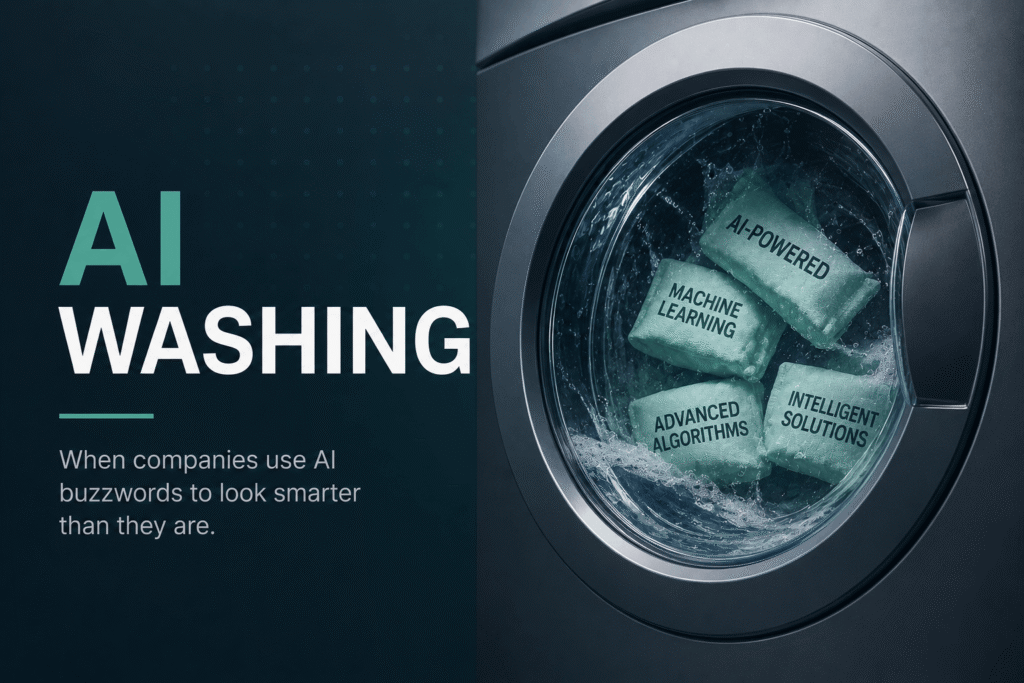
AI washing is a deceptive marketing practice where a company overstates, exaggerates, or outright fabricates its use of artificial intelligence to make a product, service, or business seem more advanced than it actually is. It works by borrowing the credibility and buzz surrounding AI to attract customers, investors, or media attention, even when little or no genuine machine learning sits underneath the hood. The term itself is a direct riff on “greenwashing,” and the concept has drawn scrutiny from trademark and unfair competition experts examining whether AI-related claims could constitute unlawful business practice. Think of it as the tech industry’s version of putting a “organic” sticker on a candy bar that’s mostly corn syrup.
Why This Is Suddenly Everywhere (And Why It Matters Right Now)
Here’s the thing. AI hype didn’t sneak up on us. It arrived like a freight train after ChatGPT launched, and every company with a Series A pitch deck suddenly needed an “AI story.”
Sound familiar? It should. We’ve seen this movie before.
AI washing has been compared to the dot-com bubble, when businesses appended “dot-com” to their name just to boost valuation. Back then, nobody needed a working internet strategy. They just needed the label. Today, nobody necessarily needs a working model. They need the word “AI” somewhere in the press release.
And investors keep rewarding it. Research from venture firm MMC Ventures, sponsored by Barclays, found that startups labeled as AI companies attracted between 15% and 50% more funding than comparable technology firms that weren’t branded that way. That same study reviewed 2,830 self-described “AI startups” across 13 European countries and found that roughly 40% showed no real evidence that artificial intelligence was material to their product. That data is from 2019, well before generative AI exploded, which honestly makes it more alarming, not less. If four in ten companies were faking it before the hype cycle got this intense, imagine the ratio today.
Here’s the kicker: this isn’t just a startup problem anymore. It’s showing up in layoffs, too. In 2026, a wave of mass tech layoffs got attributed to “AI innovation” and AI-driven restructuring, when the real story was closer to balance sheet cleanup. Blaming a robot for your bad quarter sounds a lot better in a press release than admitting you overhired in 2022.
The Gap Nobody Talks About: How AI Washing Actually Gets Built
Most articles on this topic list a few famous examples and call it a day. That’s the shallow version. The deeper question is: what does the actual mechanism of AI washing look like inside a company?
It usually follows one of three patterns.
Pattern one: the wizard behind the curtain. This is the Nate Inc. playbook. A company promises AI-driven automation, but humans quietly do the work manually behind the scenes. Amazon faced similar scrutiny over its “Just Walk Out” checkout technology, after reports suggested the supposedly AI-powered system relied heavily on human reviewers monitoring transactions, which Amazon has since pushed back on.
Pattern two: the buzzword blender. This is subtler and far more common. A company runs a basic recommendation algorithm, a spellcheck feature, or standard search indexing, then rebrands it as “AI-powered” because, technically, some of the underlying tools involve machine learning somewhere in the supply chain. It’s not a lie exactly. It’s a stretch dressed up as a fact.
Pattern three: the vague halo. No specifics, no technical documentation, just a warm fuzzy claim that “AI enhances your experience.” Companies engaging in this pattern often offer vague definitions, refusing to specify which elements are actually intelligent versus which rely on traditional software or human input. If a vendor can’t tell you which model they use, what data trained it, or how they handle errors, that’s your signal to ask harder questions.
I’ll be honest. Pattern two is the one that worries me most, because it’s legal, deniable, and everywhere. It’s also the hardest one for regulators to touch, since nobody explicitly lied. They just let you assume.
Deep Dive: What the SEC Is Actually Doing About It (2024-2026 Timeline)
This is where things get interesting, and where a lot of coverage stays frustratingly surface-level.
The SEC’s enforcement campaign didn’t start with a bang. It started with two quiet settlements. In March 2024, the SEC brought simultaneous actions against investment advisory firms Delphia and Global Predictions for making false and misleading statements about their use of AI in investment processes, and both firms agreed to civil penalties totaling $400,000.
Then it escalated. Fast.
- January 2025: The SEC charged Presto Automation Inc., marking the first AI washing enforcement action ever brought against a publicly traded company.
- April 2025: In its most dramatic case yet, the SEC and the DOJ filed parallel criminal and civil actions against Albert Saniger, founder of Nate Inc., alleging he raised more than $42 million by falsely marketing the company’s shopping app as using AI, machine learning, and neural networks, when transactions were reportedly processed manually by overseas contract workers.
- Throughout 2025: The SEC’s newly formed Cyber and Emerging Technologies Unit made clear that “rooting out” AI washing fraud schemes remained an immediate enforcement priority, even as the broader enforcement docket shrank under new leadership.
That last point matters. Total SEC enforcement actions actually dropped 22% in fiscal year 2025 compared to the prior year, with 456 total actions and roughly $17.9 billion in monetary relief ordered. Fewer cases overall, but AI washing specifically got flagged as untouchable territory. Translation: the agency is doing more with less, and this is one of the few buckets getting extra attention regardless of who’s in charge.
And it’s not just securities law. The Federal Trade Commission has run its own sweep, called Operation AI Comply, targeting companies that use AI claims to deceive or harm consumers directly. Meanwhile, private litigation is picking up the slack where regulators pull back. Securities class actions citing AI misrepresentation increased 100% between 2023 and 2024, with no signs of slowing through 2025, and courts have already started ruling against companies over it. One 2025 decision out of the Southern District of New York found that healthcare logistics company DocGo Inc. misled investors about a “proprietary central AI system” that supposedly managed complex operations.
This is genuinely global too, not just a US story. A working group under the International Trademark Association’s Unfair Competition Committee surveyed AI washing practices across Australia, New Zealand, Brazil, China, Europe, and the United States, concluding that while dedicated AI-washing legislation is still rare, existing consumer protection and unfair competition frameworks are increasingly being stretched to cover it.
How to Spot AI Washing Before It Costs You
You don’t need a law degree to protect yourself here. You need a slightly more suspicious eyebrow.
Ask these questions before you trust an “AI-powered” claim:
- Can they name the actual technology? Vague claims of “intelligent” software without mentioning specific models, algorithms, or techniques (natural language processing, computer vision, predictive modeling) are a warning sign, not a technical detail they simply forgot to include.
- Do they have documentation? Legitimate AI companies typically publish case studies, white papers, or technical explanations of how their models work and how they mitigate bias or hallucination risk. If a sales rep can’t answer basic questions about data training or error handling, that’s a red flag.
- Does the claim survive a “how” question? “Our AI personalizes your experience” is marketing. “Our recommendation model uses collaborative filtering trained on 2 million user sessions” is a fact you can verify.
- Would the claim hold up in a pitch deck footnote? If a company wouldn’t put the claim in writing to the SEC exactly as they said it in a press release, that gap is the tell.
I’ve made this mistake myself, more than once, taking a vendor’s word for it because the demo looked slick. Slick demos are cheap. Working systems are not.
The Investor’s Dilemma: Why AI Washing Keeps Working
Here’s an uncomfortable truth most guides skip over. AI washing works precisely because investors want it to work.
When SEC Enforcement Division Director Gurbir Grewal warned firms to “stop” rushing AI claims to “capitalize on growing investor interest,” and to ask themselves whether their representations were accurate or simply aspirational, he wasn’t describing a rare bad actor. He was describing an entire funding ecosystem that rewards the label over the substance.
Wondering why founders keep doing this even with regulators watching? Because the math still favors them, at least in the short term. Startups tagged “AI” pull in dramatically more capital, valuations climb faster, and by the time anyone asks hard technical questions, the founder has often already exited or pivoted the narrative. The penalty, when it comes, arrives years later and lands on a smaller number of people than the funding round originally enriched.
That asymmetry is the real engine behind AI washing. Not deception for its own sake. Deception because the incentives are lopsided.
Comparing Real AI Adoption vs. AI Washing: A Practical Framework
| Signal | Genuine AI Use | AI Washing |
|---|---|---|
| Technical specificity | Names the model type, training data, and limitations | Uses vague terms like “intelligent” or “smart” with no detail |
| Documentation | White papers, technical blogs, published benchmarks | Marketing copy only, no technical backup |
| Consistency | Claims match what engineers and job postings describe | Marketing overstates what job listings or patents suggest exists |
| Regulatory posture | Discloses limitations, risks, and human oversight | Avoids specifics that could be checked against reality |
| Funding language | Tied to measurable outcomes (accuracy, speed, cost reduction) | Tied to vague “transformation” or “revolutionary” language |
This isn’t exhaustive, but it’s a gut check you can run in five minutes on any pitch deck, product page, or press release.
Common Misconceptions About AI Washing
Let’s clear up a few things people consistently get wrong.
Myth: Only shady startups do this. Not true. Even everyday examples blur the line, since search algorithms, spellcheck, and recommendation engines technically involve AI, which means huge, reputable companies can accidentally (or conveniently) overstate their AI involvement too.
Myth: If it’s not illegal, it’s fine. Legally gray doesn’t mean ethically clean. AI washing occurs whenever a company claims to use AI technology to enhance its services but, in fact, isn’t doing so, and that gap between claim and reality erodes trust in the entire industry, even for companies doing honest work.
Myth: Regulators only care about big public companies. The SEC’s earliest cases targeted investment advisers, not tech giants. Small and mid-sized firms are absolutely within scope, especially in finance, healthcare, and consumer tech where investor and consumer harm is easiest to prove.
Myth: This is just a US problem. It isn’t. The international trademark survey mentioned earlier covered five separate global regions, and the UK’s advertising regulator already enforces standards around misleading AI claims, separate from anything the SEC does.
When AI Washing Overlaps With Greenwashing
This connection gets almost no coverage, and it should. Training large AI models is genuinely resource-intensive, requiring massive data centers, water for cooling, and heavy electricity draw. Companies that inflate their AI capabilities to look innovative are frequently the same companies quiet about the environmental cost of the infrastructure behind those claims. If a business is comfortable stretching the truth about what its technology actually does, it’s worth wondering how honest that same business is being about its supply chain, its emissions, or its labor practices. Accountability tends to travel as a package deal, not an à la carte menu.
What This Means for Consumers, Employees, and Job Seekers
If you’re evaluating a product, a job offer, or an investment, don’t just ask “does this use AI?” Ask “what does the AI actually do, and can someone explain it to me in plain language without buzzwords?”
If you’re an employee at a company that just announced layoffs “to focus on AI-first strategy,” it’s fair to ask leadership for specifics. What is the AI actually replacing? What’s the measurable outcome expected? Vague answers here often mean the AI framing is doing PR work that a plain admission of cost-cutting wouldn’t accomplish nearly as well.
And if you’re a founder or marketer reading this wondering where the line sits, here’s the simplest test I know: would your claim survive being read aloud, word for word, in front of the SEC’s enforcement division? If the honest answer is “probably not,” rewrite the claim before you publish it, not after someone else notices the gap.
Frequently Asked Questions
What exactly counts as AI washing? AI washing is any marketing claim that overstates or fabricates a company’s actual use of artificial intelligence. It ranges from outright fraud, like manually processing transactions while claiming full automation, to subtler exaggeration, like calling basic automation “AI-powered” without technical substance behind it.
Is AI washing illegal? It can be, depending on context. When public statements mislead investors, the SEC has imposed civil penalties on firms for false AI-related claims, and the DOJ has pursued criminal fraud charges in more extreme cases. Consumer-facing claims can also trigger FTC action under existing deceptive advertising rules.
How common is AI washing really? Hard to say precisely today, but historical data offers a clue. A 2019 review found that roughly 40% of self-labeled AI startups in Europe showed little real evidence of AI in their products, and that was years before generative AI made the label even more tempting to slap on everything.
Can big, well-known companies get accused of AI washing too? Yes. Amazon faced scrutiny over its cashierless “Just Walk Out” technology, and multiple public companies, including Presto Automation, have faced SEC action specifically for AI-related misstatements.
What should I do if I suspect a company is AI washing? Ask for technical specifics, request documentation, and compare marketing claims against job postings, patents, or engineering blog posts. If the company is publicly traded and you believe investors were misled, the SEC accepts tips through its official whistleblower program.
Why do companies keep doing this if regulators are cracking down? Because the financial upside still outweighs the risk for most founders. Funding rounds close in months. Enforcement actions take years. By the time the penalty arrives, the reward has often already been collected.
Is AI washing the same thing as greenwashing? They’re cousins, not twins. Both involve overstating a positive attribute to attract customers or investors, and the term “AI washing” was deliberately coined as an analogy to greenwashing. But AI washing targets technological credibility specifically, while greenwashing targets environmental credibility.
The Bottom Line
AI washing isn’t going away anytime soon. Not while funding rewards the label more than the substance, and not while “AI-first” sounds so much better in a press release than “we cut costs.” What’s changing is the consequence. Regulators on three continents are now actively building case law, precedent, and enforcement muscle around this exact issue, and private litigation is filling in wherever public enforcement slows down.
Here’s what actually matters if you take one thing from this: stop asking whether something “uses AI.” Start asking what it does, how, and whether anyone will still say the same thing under oath.
If you’re building a product, be the company that can answer that question honestly. If you’re buying one, be the person who asks it before you sign the check.
Have you spotted an obvious case of AI washing in a product you use? Share it in the comments, it helps the rest of us build a better radar for this stuff.