
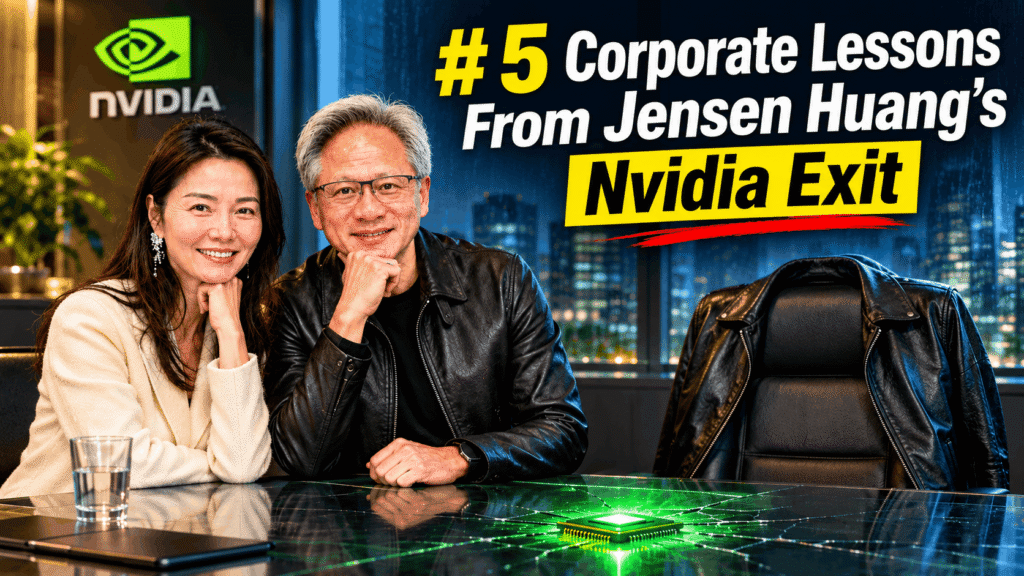

What Nvidia’s sudden leadership change reveals about founder risk, insider threats, and succession planning, for every board watching.
Nvidia spent three decades building Jensen Huang into the most recognizable CEO in tech, maybe the most recognizable executive of the entire AI era. Then, in less than a week, the company that had briefly outweighed entire national stock markets watched somewhere between $490 billion and $600 billion in value disappear, depending on which trading session you use as a baseline. On November 12, 2026, Nvidia’s board announced that Huang had resigned as president, CEO, and a board member, effective immediately, ending a 33-year run that started when he co-founded the company in 1993.
The headlines fixated on the trigger. Four days earlier, Huang had told employees he’d been unfaithful to his wife, and reporting tied one of his relationships to a Chinese businesswoman US intelligence officials suspected of passing information back to Beijing. China’s foreign ministry called the spying claim “unsubstantiated.” Nvidia’s board has said it has no reason to think national security or company secrets were compromised, though the independent investigation it launched is still working through the full picture.
That’s the tabloid version of this story. The version that should actually keep board members up at night looks different. It isn’t about an affair. It’s about what the affair exposed: how founder-brand fusion creates instant reputational contagion, how human relationships remain the one attack surface no firewall covers, why delayed succession planning is a bet almost nobody should make, and how dependent even the most dominant company on earth can be on one irreplaceable person.
What Happened, in Plain Terms
Jensen Huang resigned as Nvidia’s CEO on November 12, 2026, after admitting to an extramarital affair and facing scrutiny over a separate relationship that drew US intelligence attention because of its ties to a Chinese national. Nvidia’s chief financial officer, Colette Kress, became interim CEO while keeping her finance title, and Harvey Jones, the former chief executive and executive chairman of Synopsys, became Nvidia’s first-ever independent board chair. For anyone running or governing a company, the episode is already a case study in integrity, insider risk, succession planning, and key-person dependence.
The Timeline, Start to Finish
- June 2024: Huang is reportedly seen socially with Alice Huang (also known as Huang Le) in Taiwan.
- September 2024: The US Commerce Department’s Bureau of Industry and Security opens an inquiry into Megaspeed, the Singapore-based firm where Alice Huang was an executive, over possible export-control circumvention.
- October 29, 2026: The New York Times reports on Huang’s relationship with Alice Huang and on US intelligence suspicions about her.
- November 8, 2026: Huang admits infidelity in a message to employees and apologizes to his wife, Lori, and his family. Nvidia’s board announces an independent investigation the same day.
- November 10, 2026: The board retains the law firm Wachtell, Lipton, Rosen & Katz and former federal prosecutor Joon H. Kim to lead that investigation.
- November 11, 2026: Reports surface of a second relationship, this one involving a Nvidia employee who reported to Huang.
- November 12, 2026: Huang resigns as president, CEO, and board member. Colette Kress becomes interim CEO; Harvey Jones becomes independent board chair.
- November 17, 2026: Nvidia reports third-quarter earnings exactly as originally scheduled.
Lesson 1: Integrity Stops Being Private the Moment You’re the Brand
Modern founder-CEOs don’t just run their companies. They are their companies, at least in the market’s eyes. Huang’s leather jacket became as recognizable as Nvidia’s own logo, and his image as a devoted family man, married to his college lab partner Lori for over four decades, was part of that package. Investors weren’t only pricing Nvidia’s chips. They were pricing Huang’s judgment, his relationships with world leaders, and his read on where AI demand was heading two years out. You could think of it as a kind of personal premium baked into the valuation, on top of the actual business.
So when the gap opened between that image and his admitted infidelity, the market didn’t treat it as a private family matter. It treated it as new information about the person the entire valuation had been resting on. As analyst Stephen Innes of SPI Asset Management framed it, markets had spent years paying up for Nvidia’s execution, and now they had to work out how much of that premium belonged to Huang personally rather than to the company itself.
The lesson for anyone building a founder-led brand isn’t that personal conduct needs policing by the board. It’s that personal ethics are already a load-bearing part of institutional trust, whether anyone writes that into a governance policy or not. Pretending otherwise just means getting blindsided by it later, usually in a single trading session.
Lesson 2: The Weakest Link in Your Cybersecurity Program Still Walks on Two Legs
Nvidia has been here before, technically speaking. In 2022, the hacking group Lapsus$ breached the company, stole employee credentials, and leaked proprietary source code. That was a conventional cyberattack: exploit a system, steal data, extort the company. Security teams know how to model that kind of risk, even when they can’t fully stop it.
What happened this time is harder to patch. Intelligence officials reportedly assessed that Alice Huang, an executive at the Singapore-based firm Megaspeed, had been recruited by China’s Ministry of State Security, and that she developed a close relationship with Jensen Huang over a period of years before any of it became public. The Commerce Department had already been investigating Megaspeed’s China ties since September 2024, more than two years before the relationship made headlines. That gap, between when regulators started asking questions and when Nvidia’s own board had to act, is the real takeaway.
Nvidia isn’t alone in facing this kind of exposure. In October 2026, OpenAI confirmed that the FBI had arrested one of its employees, a Saudi national, after discovering a hidden recording device planted in an executive conference room. Federal prosecutors alleged he may have had backing from a foreign government. Two of the most important AI companies on the planet, within weeks of each other, found that their most sensitive rooms and relationships, not their networks, were the actual point of failure. According to Fortinet’s 2025 Insider Risk Report, 77 percent of organizations had experienced at least one insider-related data-loss incident over an 18-month stretch, which suggests this isn’t a one-off problem for either company.
Boards spend enormous budgets on zero-trust architecture, endpoint detection, and penetration testing. Almost none of that touches the risk of a trusted insider, a close personal relationship, or a cheap recording device in a USB port. Honeytraps and social engineering don’t show up on a vulnerability scan, and that is exactly why they keep working.
Lesson 3: Succession Planning Is Not Something You Get to Do During a Crisis
Compare how Nvidia’s transition actually happened to how two of the most closely watched American companies handled theirs. Nvidia’s board named Colette Kress interim CEO the same day Huang resigned, with no permanent successor announced and a search still underway. Kress brings over a decade at Nvidia and deep knowledge of its finances, which matters a great deal, but “interim” is doing a lot of work in that title.
Apple did this differently. Tim Cook announced in April 2026 that John Ternus, a 25-year Apple veteran who had led hardware engineering, would become CEO that September, with speculation about Ternus already building for roughly a year before the announcement. Cook stayed on as executive chairman. Nobody woke up one morning wondering who was actually running Apple.
Berkshire Hathaway went further still. Warren Buffett named Greg Abel his designated successor back in 2021, the board formally voted to make the transition official in May 2025, and Abel took over as CEO on January 1, 2026, roughly five years after the plan first became public. Buffett didn’t sell a single Berkshire share as part of the handover, a small detail that told shareholders exactly how confident he was in it.
Founder-led and family-run companies everywhere, including plenty in India’s startup and business community, fall into the same trap: treating succession as a someday problem instead of a standing governance requirement. Delaying it until a crisis forces the issue almost always costs more, in valuation and in boardroom stability, than naming and preparing a successor years ahead of time ever would.
Lesson 4: Key-Person Risk Isn’t a Line in a Filing, Until It Suddenly Is
Key-person risk is the exposure a business carries when its value, operations, or market confidence depend disproportionately on one individual, someone whose departure, incapacity, or scandal could do real financial damage. Most companies acknowledge it in a single paragraph buried deep in their risk disclosures and move on.
SpaceX didn’t get to be that casual about it. When the company filed its S-1 for its 2026 IPO, it disclosed, in plain language, that it carries no key-person life insurance on Elon Musk, despite calling him the “driving force behind our growth, innovation, and operational success.” The filing went on to warn that losing him could seriously disrupt the company’s entire management structure. That is about as direct as a risk factor gets, and it exists mainly because securities law forces public companies to say the quiet part out loud.
Nvidia never had to file language that blunt, because until November 2026 it never had to publicly confront a founder-departure scenario. But the market effectively wrote that risk disclosure itself, in real time, by repricing the stock the moment Huang’s continued leadership became uncertain.
Boards can’t manufacture a second Jensen Huang or a second Elon Musk, and pretending a founder could be swapped out like an interchangeable part would be its own mistake. What boards can actually do is decentralize institutional knowledge across more than one person, build and rehearse an emergency succession protocol before they need it, and price key-person dependence honestly in their own planning instead of treating it as something that only happens to other companies.
Lesson 5: Geopolitics Is Now a Governance Risk, Not Just a Trade Issue
There’s a fifth lesson that gets lost when this story is told purely as a personal scandal. The Megaspeed situation was never only about a relationship. It unfolded alongside an active federal investigation into whether a major Nvidia customer was helping Chinese buyers route around US export controls, congressional inquiries, and reportedly a presidential briefing on the underlying intelligence. Add in that Chinese regulators had separately summoned Huang earlier in 2025 over alleged “backdoor safety risks” in Nvidia chips sold into China, and the picture is of a company operating right on the fault line of US-China tech competition.
For any company with global supply chains or customers caught inside that rivalry, a CEO’s personal relationships, travel patterns, and business contacts are no longer siloed away from national-security exposure. Regulators, lawmakers, and reporters are already treating them as connected. Boards overseeing globally exposed companies need a governance lens that takes geopolitical entanglement as seriously as financial risk or cyber risk, because everyone outside the boardroom already does.
The Asymmetry of Reputation
Here’s the paradox sitting underneath all of this. Corporate and personal credibility took Jensen Huang 33 years to build. It took the market about a week to start repricing it. Nvidia’s underlying business, for what it’s worth, hadn’t actually slowed down. The company’s most recent quarterly revenue stood at $96.2 billion, up 106 percent year over year, and its next earnings report went ahead exactly as scheduled on November 17, right on top of the leadership chaos.
So the question worth sitting with isn’t really about Jensen Huang anymore. It’s about every other board reading this and quietly running the numbers on their own company. How many boards have actually modeled what happens to their balance sheet, their customer relationships, and their stock price if their most essential executive became unavailable tomorrow, for any reason at all? Most haven’t. Not until they’re forced to.
Frequently Asked Questions
Did Jensen Huang resign from Nvidia?
Yes. Nvidia announced on November 12, 2026, that Huang had resigned as president, CEO, and a member of the board, effective immediately, after 33 years leading the company he co-founded.
Is Alice Huang confirmed to be a Chinese spy?
No. US intelligence officials reportedly assessed that she may have been recruited by China’s Ministry of State Security, but no public proof has been presented, and China’s foreign ministry has called the allegation unsubstantiated.
Who is running Nvidia now?
Colette Kress, Nvidia’s chief financial officer since 2013, is serving as interim CEO while keeping her CFO title. The board had not named a permanent successor as of mid-November 2026.
Did Nvidia’s financial performance cause Huang’s resignation?
No. Nvidia’s business kept growing through the crisis, with its most recent quarterly revenue at $96.2 billion, up 106 percent year over year. The resignation followed personal-conduct allegations and an ongoing independent investigation, not a financial or operating failure.
How much value did Nvidia lose after the resignation?
Estimates vary depending on the exact trading session and baseline used, generally ranging from roughly $490 billion to over $600 billion in lost market value during the week of November 9 through 13, 2026.