

Here is a number that should stop you cold. In 2020, the best AI system on the ARC-AGI-1 reasoning test scored 78.8 percent. By early 2026, a frontier model cracked 93 percent. Then the researchers who built that test launched a harder one, and the top machine scored under one percent while ordinary people breezed through it.
That whiplash is the whole story of artificial general intelligence right now. We keep declaring machines almost-human, then discovering a gap we hadn’t measured yet.
So let’s cut through the noise. This guide covers what AGI actually is, why smart people violently disagree about when it arrives, how we’re trying to measure it, and what it means for your job, your money, and the strange corporate wars being fought over a milestone nobody can define. No hype. No doom. Just what the evidence says as of mid-2026, and where the honest uncertainty lives.
What Is AGI, Really? A Definition You Can Actually Use
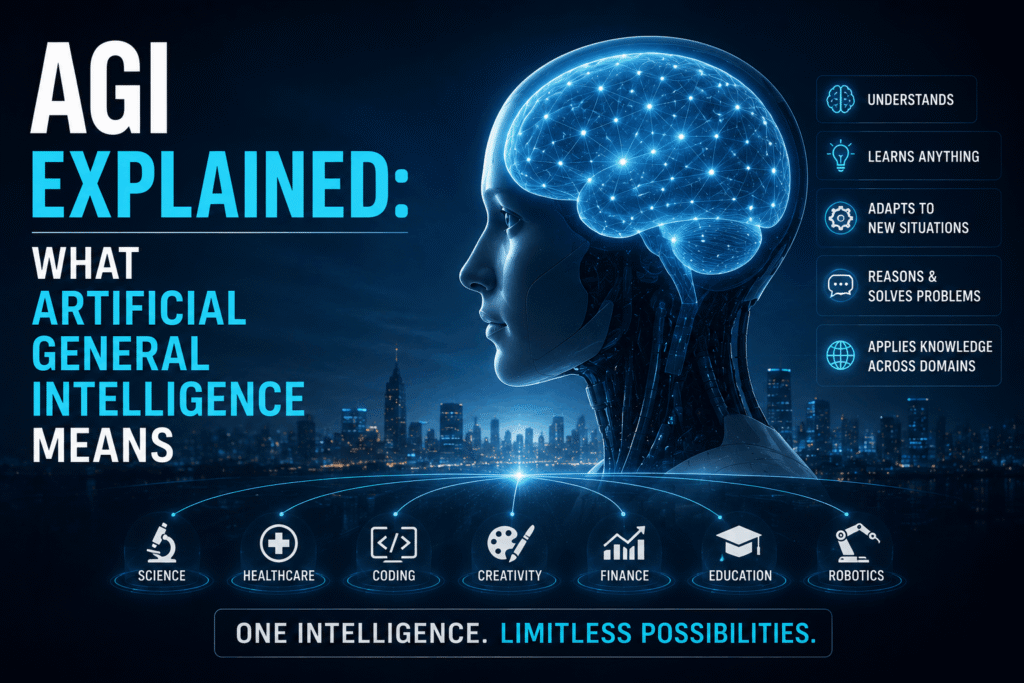
Artificial general intelligence is a type of AI that can understand, learn, and apply knowledge across almost any intellectual task a human can, rather than being locked into one narrow job. Unlike today’s narrow AI, which needs retraining for every new problem, AGI would transfer skills between domains, reason through unfamiliar situations, and pick up new abilities on its own. As of 2026, no system has clearly crossed this line, though several frontier models are pressing against pieces of it.
That definition sounds tidy. It isn’t.
Here’s the uncomfortable truth the marketing decks skip: there is no agreed-upon definition of AGI, and that vagueness is causing real problems. OpenAI’s charter describes AGI as “highly autonomous systems that outperform humans at most economically valuable work.” François Chollet, who created the ARC-AGI benchmark, frames it completely differently. For him, intelligence is skill-acquisition efficiency, meaning a system that can pick up genuinely new skills outside its training data. Cognitive scientist Gary Marcus calls AGI a shorthand for intelligence that is flexible and general, with reliability comparable to or beyond a human’s.
Notice how these barely overlap. One is about economic output. One is about learning speed. One is about flexibility and trust. A machine could satisfy one definition and flunk the others.
My favorite test comes from Apple cofounder Steve Wozniak, and it’s deceptively simple: could a robot walk into a stranger’s house and make a cup of coffee? To do that, it has to understand what a kitchen is, find the coffee, work an unfamiliar machine, open drawers, and improvise when something isn’t where it expects. A toddler can’t do it, but an average adult draws on a lifetime of common sense to pull it off. That common sense, applied to a novel environment, is exactly what machines still lack.
The term itself is younger than people assume. Physicist Mark Gubrud used “artificial general intelligence” in 1997, and researchers Shane Legg and Ben Goertzel popularized it around 2002, partly to distinguish real general intelligence from the narrow systems that kept getting called “AI.” You can read the fuller history on the Wikipedia entry for artificial general intelligence, which does a solid job tracing the tangled lineage from Alan Turing to today.
Why the “AGI Is Almost Here” Timelines Contradict Each Other So Wildly
Ask ten experts when AGI arrives and you’ll get answers spanning 2026 to 2116. That’s not a rounding error. That’s a field that fundamentally does not agree with itself, and understanding why matters more than picking a date.
Start with the optimists, because they’re loud. Dario Amodei of Anthropic, Sam Altman of OpenAI, and Elon Musk of xAI have all placed AGI-level capability somewhere between late 2026 and 2027. Anthropic’s formal submission to the U.S. Office of Science and Technology Policy stated the company expects powerful AI systems to emerge in late 2026 or early 2027. Microsoft AI chief Mustafa Suleyman has predicted human-level performance on most professional tasks by around 2027.
Now the moderates. Demis Hassabis of Google DeepMind, a Nobel laureate who tends to weigh his words, puts roughly 50 percent odds on AGI around 2030 and has said it will “begin to happen in 2030.” His DeepMind colleague Shane Legg has held to a 2028 estimate for a 50 percent chance of “minimal AGI” for well over a decade, which is a rare case of a prediction that hasn’t drifted.
Then the crowd. Metaculus, a forecasting platform with a strong track record and nearly 2,000 responses on its AGI question, currently sits around a 25 percent chance by 2029 and 50 percent by 2033. A survey of AI safety leaders taken before the 2026 Summit on Existential Security found most 50 percent estimates clustering between 2030 and 2035.
And the skeptics, who deserve far more airtime than they get. A 2023 survey of 2,778 researchers landed on a median 50 percent probability of high-level machine intelligence by 2047. When AIMultiple reviewed ten separate surveys covering more than 5,200 predictions, most pointed to a 50 percent likelihood somewhere between 2040 and 2061.
So who’s right? Here’s the kicker: the single biggest driver of these gaps isn’t data, it’s definition. The safety-leaders survey specifically noted that including physical-labor jobs in the AGI definition pushed people’s estimates years later. Change what “AGI” means and you change the answer by decades. When you see a scary or thrilling headline number, your first question should always be: what did they count as AGI?
The Contrarian Case: 76 Percent of Experts Think Scaling Alone Won’t Get Us There
This is the part the frontier labs would rather you didn’t dwell on.
In 2025, the Association for the Advancement of Artificial Intelligence surveyed 475 AI researchers, most from academia. The finding was blunt: 76 percent said that simply scaling up current approaches to reach AGI is “unlikely” or “very unlikely” to succeed. Read that again. Three out of four people who build these systems for a living doubt that bigger models plus more compute equals general intelligence. IBM’s own reporting on the survey quotes Fellow Francesca Rossi, a past AAAI president, arguing that models need to truly understand cause and effect rather than just predict the next word. You can read IBM’s summary of that research for the full argument.
Why the skepticism? Because the benchmarks keep exposing the same crack. When researchers analyzed the ARC Prize 2025 results, they found that AI reasoning performance stays “fundamentally constrained by knowledge coverage.” Translation: these systems are brilliant when a problem resembles something in their training, and surprisingly brittle when it doesn’t. Humans generalize from a handful of examples. Machines still need hundreds of thousands. The 2025 competition winners needed vast piles of synthetic examples just to reach 24 percent on the harder ARC-AGI-2 test, where humans score around 75 percent.
Even the boosters hedge more than their headlines suggest. Hassabis has said we need “one or two more breakthroughs” beyond current techniques, calling out gaps in reasoning, planning, and memory. Gary Marcus went further, describing a recent stretch as “devastating” for AGI optimism.
Now, I’ll be honest about my own read: I think the skeptics are right that scaling alone won’t be sufficient, and also that this doesn’t mean AGI is far away. Those two things can both be true. New architectures, better reasoning loops, and hybrid systems that separate knowledge from reasoning could arrive fast. The skeptics aren’t saying it’s impossible. Most are saying the current recipe needs a new ingredient. That’s a meaningfully different claim from “never,” and it’s worth holding onto when someone tries to sell you certainty in either direction.
How Do We Actually Measure Progress Toward AGI?
You can’t manage what you can’t measure, and AGI has a measurement problem. But one project has become the closest thing the field has to an honest yardstick, and its recent history tells you exactly where machines stand.
The ARC-AGI benchmark, created by François Chollet, tests something most exams don’t: the ability to solve visual reasoning puzzles that require no special training, just core human intuitions about objects, counting, and space. The ARC Prize organization runs it as an open competition precisely because it keeps catching the gap between what’s easy for humans and hard for machines.
Here’s how the three generations have gone, and the pattern is the real lesson:
ARC-AGI-1 (2019). Machines crawled from 78.8 percent in 2020, plateaued, then surged to 93 percent by 2026. Looks solved. Feels like AGI is close.
ARC-AGI-2 (2024). Introduced right as version one was falling. Models jumped from 2.5 percent to 68.8 percent in under two years, still short of the roughly 75 percent human baseline, and the best open competition entry sat at just 24 percent. Suddenly the gap reopens.
ARC-AGI-3 (launched March 2026). This one abandons static puzzles for interactive games where an agent has to explore, plan, remember, and figure out the goal on its own. The results are humbling. As of March 2026, Google’s Gemini 3.1 Pro led at 0.37 percent, OpenAI’s GPT-5.4 hit 0.26 percent, and Anthropic’s Opus 4.6 reached 0.25 percent. Meanwhile, over 1,200 human players completed thousands of these games, most of them successfully.
Sit with that contrast. On the newest test of adaptive, agentic intelligence, the best machines score a fraction of a percent while regular people just play the game. The ARC Prize team put $2 million on the table for 2026, with a $700,000 grand prize for any system that matches human-level efficiency. As their own tagline states, scaling alone will not reach AGI, and each new benchmark version keeps proving it.
The takeaway isn’t that machines are dumb. They’re astonishing at tasks with good training coverage. The takeaway is that “acing a benchmark” and “being generally intelligent” are different achievements, and the second one keeps slipping over the horizon as we learn to measure it better.
The AGI Money War Nobody Saw Coming: OpenAI vs. Microsoft
Want proof that a fuzzy definition can cost billions? Look at what just happened between the two biggest names in AI.
When Microsoft first invested in OpenAI, the contract contained a genuinely wild clause. Microsoft’s license to OpenAI’s technology applied only to “pre-AGI” systems, and OpenAI’s nonprofit board, not Microsoft, held sole authority to declare when AGI had been reached. In plain terms, OpenAI could flip a switch, announce “we’ve built AGI,” and legally cut Microsoft off from its most advanced models. A second provision tied a similar trigger to OpenAI generating $100 billion in profit.
For years this felt theoretical. Then models got good enough that it didn’t.
The fight got personal. Microsoft CEO Satya Nadella publicly rejected OpenAI’s economic-output definition of AGI, calling it “nonsensical benchmark hacking,” and argued the only benchmark that matters is the world economy growing at 10 percent a year. Sam Altman himself admitted the definition shifts depending on who you ask, including the same person on different days. When your multi-billion-dollar partnership hinges on a word, and you can’t define the word, you have a problem.
How did it end? Quietly, in the way these things do. By late April 2026, the companies restructured. Microsoft’s license now runs through 2032 and is non-exclusive, and the terms became independent of OpenAI’s technology progress. As several observers put it bluntly, the AGI clause is now dead. The most consequential contractual definition of AGI in business history got negotiated out of existence because it was too vague to enforce.
The lesson reaches far beyond two companies. If the sharpest lawyers and richest firms on earth couldn’t pin down what AGI means well enough to write it into a contract, you should be skeptical of anyone who tells you they’ll know it the moment it arrives.
What AGI Would Actually Mean for Jobs and the Economy
Set aside the philosophy for a second, because this is where AGI stops being abstract and starts touching your paycheck.
The projected upside is genuinely staggering. McKinsey has estimated that generative AI alone could add $2.6 trillion to $4.4 trillion in value annually, and that AI broadly could add roughly $13 trillion to global output by 2030. Goldman Sachs estimated generative AI could lift global GDP by about 7 percent while exposing the equivalent of 300 million full-time jobs to automation. The market for AI agents, the delivery mechanism for a lot of this value, is forecast to grow from around $7.84 billion in 2025 to over $52 billion by 2030.
But GDP is a slippery number, and here’s the part that doesn’t fit on a triumphant slide. Output can rise while workers hurt. In 2025, U.S. layoffs hit their highest level since the 2020 pandemic, and roughly 55,000 job cuts were directly attributed to AI according to Challenger, Gray & Christmas. Amazon eliminated about 14,000 corporate roles, citing leaner AI-enabled structures. Workday cut roughly 1,750 positions to shift resources toward AI. The damage tends to show up first not in the unemployment rate but in the quiet disappearance of entry-level analyst, junior engineer, and support roles.
Geoffrey Hinton, the Nobel-winning “godfather of AI,” frames the risk sharply. He argues AI will raise profits while increasing unemployment, and he blames the economic system rather than the technology itself. He’s skeptical that universal basic income solves the deeper loss of purpose and dignity that work provides, even if it pays the bills.
Who should actually worry, and who shouldn’t? If your work is mostly predictable knowledge tasks with abundant training data, such as routine drafting, first-pass analysis, or standardized coding, exposure is real and near-term. If your work depends on physical dexterity in messy environments, high-trust human relationships, or genuine novel problem-solving, the runway looks longer. And notice the flip side: AI safety leaders who included physical-labor jobs in their AGI definition pushed their timelines years later, precisely because robots making coffee in a stranger’s kitchen remains hard.
The honest answer is that nobody knows the net effect on employment, because it depends on choices we haven’t made yet about policy, taxation, and how gains get distributed. Anyone who tells you they’ve got it figured out is selling something.
The Risk Question: Existential Threat or Overblown Panic?
You can’t cover AGI honestly without the part that sounds like science fiction, because serious people take it seriously.
The concern isn’t robots deciding to hate us. It’s subtler: a system far more capable than humans, pursuing goals that aren’t quite aligned with ours, in ways we can’t easily correct. Hinton has estimated a 10 to 20 percent chance that AI could pose an existential threat, through either uncontrollable superintelligence or misuse by bad actors. A number of prominent researchers have argued that reducing extinction-level risk from advanced AI should be a global priority.
And then there’s the other camp, equally credentialed, who find the whole discussion premature. Their view, reflected in that 76 percent skepticism about scaling, is roughly this: we’re nowhere near systems capable of the kind of autonomous, general competence that would make them dangerous in this way, so obsessing over it now distracts from concrete present harms like bias, misinformation, and labor disruption.
Both things can be worth taking seriously at once. You don’t have to believe doom is imminent to think it’s wise to build safety measures before, not after, capabilities arrive. That’s just basic engineering. If 30 percent of aviation experts thought a plane might explode and 70 percent thought it was fine, you wouldn’t board without checking. Uncertainty is a reason for care, not a reason for dismissal.
Expert Perspective: What the Field’s Own Data Reveals
The most clarifying voice here might be the one arguing that AGI isn’t even the right goal. IBM Fellow Francesca Rossi, a past president of the AAAI, has cautioned that different people mean entirely different things by the term, and she draws a line worth remembering: “If AGI implies replacement, we believe AI should augment human intelligence, not replace it.”
That reframing matters. Her survey of 475 experts found not just skepticism about timelines but skepticism about the framing itself. A large share of the people closest to the technology think the useful question isn’t “when do machines match us” but “how do machines extend what we can do.” The ARC Prize team makes a complementary point from the measurement side: they define AGI as a system that can match the learning efficiency of humans, and their entire body of work shows we’re not there, because efficiency, not raw capability, is where machines still fall short.
When the builders and the measurers both tell you the goalposts are unclear and the gap is real, that’s the signal to trust over any single confident prediction.
Frequently Asked Questions About AGI
Does AGI exist yet in 2026? No system has clearly achieved AGI as of 2026, though the answer depends on your definition. Frontier models show flashes of general capability and even beat humans on some benchmarks. But on tests of adaptive, novel reasoning like ARC-AGI-3, the best machines score under one percent while ordinary humans succeed easily.
What is the difference between AI, AGI, and ASI? Narrow AI (the kind we use today) handles specific tasks like translation or image recognition. AGI would match human intelligence across virtually any intellectual domain, learning and transferring skills like a person. Artificial superintelligence, or ASI, would exceed the best humans at everything by a wide margin. AGI is considered a prerequisite for ASI, but not the other way around.
When will AGI be achieved? There’s no consensus. Lab leaders like Altman and Amodei suggest 2026 to 2027, Hassabis points near 2030, forecasters on Metaculus center around 2033, and broad surveys of researchers land between 2040 and 2061. The spread comes mostly from disagreement over what counts as AGI in the first place.
Will AGI take my job? Some roles face real near-term exposure, especially predictable knowledge work with lots of training data. In 2025, roughly 55,000 U.S. layoffs were directly linked to AI. Jobs needing physical dexterity, deep human trust, or genuine novel problem-solving appear more durable for now. The net effect on total employment remains genuinely uncertain.
Why can’t experts agree on what AGI is? Because AGI is defined by its goals, and different people have different goals. Economists frame it as outperforming humans at valuable work. Cognitive scientists frame it as flexible, efficient learning. That mismatch is so serious it helped kill the AGI clause in the OpenAI-Microsoft contract.
Is scaling current AI models enough to reach AGI? Probably not on its own, according to most researchers. A 2025 AAAI survey found 76 percent believe scaling current approaches is unlikely to produce AGI. Many argue we need new architectures that add structured reasoning and causal understanding, not just more data and compute.
Could AGI be dangerous? Serious researchers, including Geoffrey Hinton, estimate a meaningful (10 to 20 percent) chance of severe risk from advanced AI, whether through misalignment or misuse. Others consider such fears premature given current limitations. The prudent stance is building safety measures ahead of capability rather than after.
How is progress toward AGI measured? Through benchmarks that test general reasoning, most notably the ARC-AGI series, which measures whether machines can solve genuinely novel problems as efficiently as humans. Because these tests keep getting harder as models improve, they’ve become a reliable indicator of the real gap between machine performance and human-like intelligence.
The Bottom Line: Three Things Worth Remembering
Strip away the hype cycles and the countdown clocks, and three durable truths remain.
First, the definition is the whole ballgame. Nearly every disagreement about AGI, from timelines to trillion-dollar contracts, traces back to the fact that no two people mean the same thing by the word. Before you accept any claim about AGI, ask what the person is actually measuring.
Second, the machines are extraordinary and limited at the same time. They can score 93 percent on a reasoning test that stumped them five years ago, and under one percent on a new one a child can pass. Both facts are true, and holding them together is the only honest way to think about this.
Third, the human questions matter more than the technical ones. Whether AGI arrives in 2027 or 2040, the decisions that shape your life are about work, income, safety, and distribution, and those are choices we make, not outcomes we await.
Artificial general intelligence may be the most important technology humanity ever builds, or it may be a moving target we chase for decades. Probably it’s both, in stages. Either way, the smartest thing you can do isn’t to predict the date. It’s to stay literate, stay skeptical of certainty in every direction, and pay attention to who benefits from each definition.
What’s your read? If you work in a field already feeling the shift, that firsthand view is worth more than any forecast. Keep watching the benchmarks, keep questioning the timelines, and don’t let anyone sell you certainty about a milestone the experts can’t even define.