
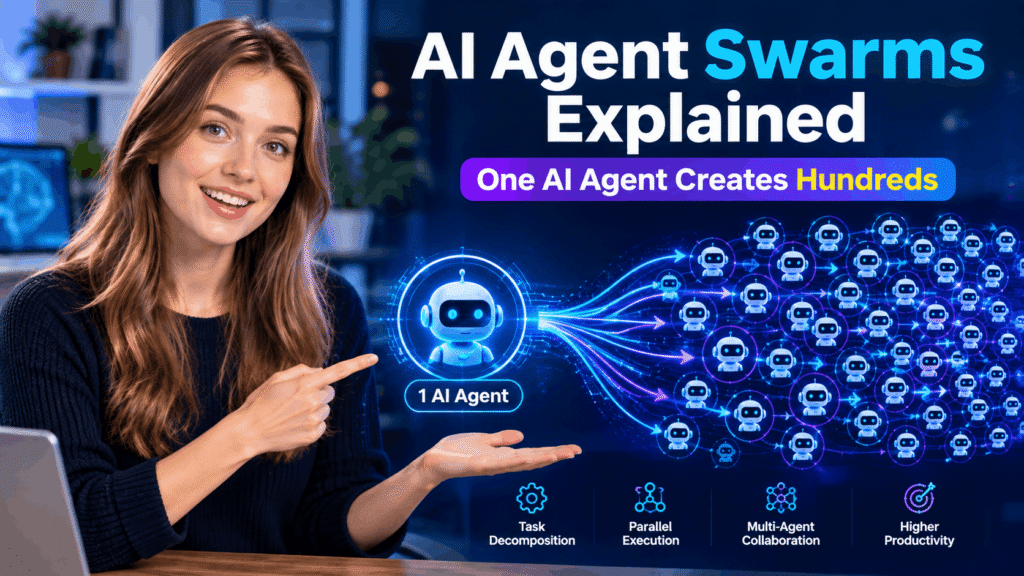

Ask an AI to research a topic today, and it doesn’t just think harder. It splits itself into a small team, sends each member off with a different assignment, and reassembles their findings when they’re done. That’s not a metaphor. It’s how Anthropic’s own Claude Research tool works right now, and it’s quietly becoming the default architecture for anything more demanding than a chat reply.
AI agent swarms are groups of specialized AI agents that split a complex task into smaller pieces, work on them at the same time, and combine the results into one output. Instead of one model trying to hold an entire problem in its head, a “lead” agent breaks the job apart, hands pieces to sub-agents, and stitches everything back together. It’s less like asking one very smart employee to do everything and more like standing up a small task force for the afternoon.
Here’s the thing nobody tells you upfront: this shift is happening for boring infrastructure reasons, not sci-fi ones. And it’s already created a security problem serious enough that Anthropic just spent a whole report on it.
Why One Agent Stopped Being Enough
Large language models have a context window – a hard limit on how much information they can hold in working memory at once. Feed a single agent fifty research questions, or a codebase with a thousand files, and it starts forgetting the beginning by the time it reaches the end. Anthropic’s engineering team ran into exactly this ceiling while building Claude’s research product, and a system with Claude Opus as the lead agent and Claude Sonnet as supporting subagents outperformed a single-agent setup by more than 90 percent. bytebytego
That’s a genuinely large jump. But it’s not free.
Multi-agent systems burn through roughly fifteen times the tokens of a standard chat conversation, and token usage alone explains around 80 percent of the performance difference between swarm and solo setups. So the honest framing isn’t “swarms are smarter.” It’s “swarms trade money and compute for the ability to parallelize thinking across multiple context windows at once.” Worth it for a sprawling market analysis. Overkill for “summarize this email.” How Anthropic Built a Multi-Agent Research System +2
There’s also a ceiling on what swarms are good at. They excel at problems that split into parallel strands of research but perform worse on tightly interdependent tasks like coding, where step four depends entirely on what step three actually produced. You can’t parallelize a conversation with yourself. bytebytego
How the Pieces Actually Fit Together
Most production swarms today follow what practitioners call the orchestrator-worker pattern. One central agent — the lead researcher — analyzes the incoming request, decides on a strategy, and writes that plan into memory before anything else happens. That memory step matters more than it sounds like it should. Long tasks can blow past the context window mid-run, and without a saved plan, the system loses the thread entirely. bytebytego
From there:
- The lead agent decomposes the task. It figures out what independent sub-questions exist and how many workers each one needs.
- Sub-agents spin up in parallel, each with its own tools, its own slice of context, and (this is the part that trips people up) no visibility into what the other sub-agents are doing.
- Results funnel back to the lead, which deduplicates, resolves contradictions, and produces one coherent answer.
Sounds clean. In practice, the “no visibility” part is where things go sideways.
An Anthropic engineer described an early version of their research system where one sub-agent investigated a 2021 automotive chip shortage while two separate sub-agents, working blind to each other, both duplicated research on 2025 supply chains — the fix required rewriting the orchestrator’s delegation prompts with explicit objectives and explicit boundaries, spelling out what each sub-agent should not touch because it belonged to someone else. That’s not a hypothetical edge case. That’s what happens by default when you hand out parallel work without airtight task boundaries. Substack
The Coordination Problem Nobody Solved Yet
Task decomposition sounds simple until you’ve watched it fail. Split a research question badly and you get either duplicated effort (three agents doing the same Google search) or gaps (nobody covers the thing that actually mattered). Split a coding task badly and you get agents overwriting each other’s files.
Industry engineers describe a related failure mode: agents that disagree and just… loop. One account describes a billing-auditor swarm where a research agent and a validation agent got stuck in a recursive disagreement over a currency conversion for twenty straight minutes before anyone noticed. The fix that’s become standard practice: a hard recursion cap, so that if a graph loops more than a handful of times without the shared state actually changing, it kicks the decision to a human instead of spinning forever.
Three coordination patterns have emerged as the practical defaults:
- Hierarchical (supervisor model). One lead agent owns the plan and delegates everything. This is what Claude Research uses. It’s easier to reason about and easier to debug, but the lead agent becomes a bottleneck.
- Peer-to-peer. Agents negotiate directly with each other, no central authority. More flexible, much harder to predict, and the failure mode above (infinite disagreement loops) shows up more often here.
- Routing. A lightweight dispatcher sends each incoming request to whichever single specialized agent handles it best, without spinning up a full parallel swarm. This one isn’t really a swarm at all, but it’s often confused with one because it’s cheaper and people market it that way.
If you’re evaluating a vendor’s “agent swarm” product, ask which of these three it actually is. A lot of marketing copy uses “swarm” for what’s really just routing, because routing is far cheaper to run and sounds less impressive on its own.
Where This Gets Genuinely Risky
Here’s the part most explainers skip entirely, and it’s the part that should actually worry you.
Anthropic published its fourth threat intelligence report on September 10, 2026, covering nine months of misuse activity it disrupted between December 2025 and August 2026. The core finding: large language models are increasingly embedded into autonomous, multi-agent frameworks that can execute complex tasks at machine speed, and this shift has narrowed the resource gap between major nation-states and lower-resource attackers. fonearena
The specifics are worth sitting with. In one documented espionage operation, AI agents monitored deployed malware over 130 days and automatically recompiled the code whenever it was detected, engaging 24 of 27 targeted institutions. In a separate extortion case, one operator used ten cloud compute workers to process 1.8 million Android app files — a scale of automated reconnaissance that would have needed a small team of humans just two years ago. Elsewhere, China-based actors automated firmware analysis on security appliances and surfaced more than a dozen potential zero-day vulnerabilities across roughly fifty targets in a single month. Anthropic September 2026 Threat Report: AI Misuse Across Cyber Operations, Surveillance and Weapons +2
Why does swarm architecture specifically matter here? Because the same property that makes swarms good at research — splitting one big goal into many small, independently-executed pieces — is exactly what let attackers scale up. Human involvement in these operations was often limited to picking a target and reviewing the final results, with the actual multi-stage attack work handed off to agents. Anthropic’s own conclusion is blunt: static keyword blocking and one-off account suspensions aren’t enough against distributed, multi-agent threats, and the fix has to happen at the architecture level, not the individual-request level. fonearenafonearena
That framing is worth remembering next time someone pitches “agent swarms” as a pure productivity story. The coordination and delegation problems that make swarms hard to build safely for your own workflows are the same properties that make them attractive to people building attacks.
Should You Actually Build One?
Probably not for most tasks. Here’s the honest breakdown.
Good fit for swarms:
- Broad research questions with many independent sub-questions (market scans, literature reviews, competitive analysis)
- Document review where each section can be assessed on its own
- Tasks where the value of a better answer clearly outweighs a 15x token bill
Poor fit for swarms:
- Coding tasks with tight dependencies between steps
- Anything where sub-tasks need to see each other’s intermediate work in real time
- Simple, single-context tasks that one well-prompted agent already handles fine
If you’re not sure which camp you’re in, ask: does this task actually split into pieces that don’t need to talk to each other while they work? If yes, a swarm might genuinely help. If every piece depends on the last one, you’re describing a pipeline, not a swarm, and adding parallel agents will just add coordination overhead without adding capability.
The Part That’s Actually New
Task decomposition, parallel execution, orchestrator-worker patterns – none of this is conceptually new. Distributed computing has used these ideas for decades. What’s new is that the “workers” now reason, make judgment calls, and occasionally disagree with each other in ways that traditional distributed systems never did. A failed API call is predictable. A sub-agent that misreads its instructions and duplicates a peer’s work, or two sub-agents that get stuck arguing over a currency conversion, is a different category of failure entirely.
That’s the real story behind “one agent becomes hundreds.” It’s not about AI getting more autonomous in some abstract sense. It’s about splitting cognition the way we’ve always split labor, and discovering that the coordination problems which plague human teams – duplicated work, miscommunication, runaway disagreements, and now, deliberate misuse — show up here too. Just faster, and at a scale no team of people could match.