
Ask your AI browser to summarize a Reddit thread. That’s it. No download, no shady link, nothing that looks like an attack. But in a disclosure published this week, security researchers at Zenity showed that a request this ordinary was enough to hijack both OpenAI’s ChatGPT Atlas and Claude in Chrome, no clicks required. Neither flaw is patched yet.
That’s where jailbreaking AI and prompt injection stand in the middle of 2026. What started in 2022 as a party trick, typing “ignore all previous instructions” into a chatbot to make it say something forbidden, has turned into the single most reported security risk for any AI system that reads outside content or takes action on your behalf. OWASP ranks it number one on its list of LLM risks. Here’s what’s actually happening, why a permanent fix might not exist, and what you can do about it starting today.
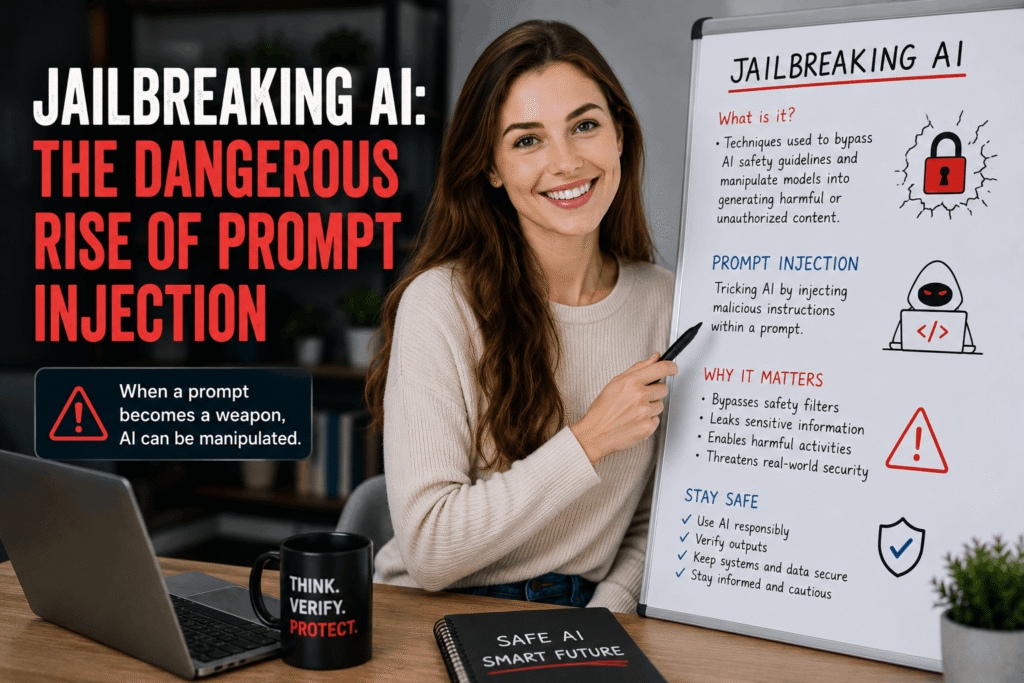
Prompt injection is an attack that hijacks an AI model’s instructions using hidden or malicious text. It happens directly, when someone types an override straight into the chat, or indirectly, when the instructions are buried inside content the AI reads later, like an email, a webpage, or a PDF. Jailbreaking is the result: once a model ignores its safety rules, attackers can push it toward actions or content its own developers explicitly tried to block.
Why Jailbreaking AI Stopped Being a Joke
Back in 2023, jailbreaking mostly meant convincing ChatGPT to role-play as “DAN,” short for Do Anything Now, an alter ego supposedly free of rules. It was a curiosity. People traded jailbreak prompts on Reddit for bragging rights, not profit.
Then AI stopped just talking and started acting. Agents now read your inbox, browse the web, click buttons, and in some cases move money. And the more an AI can actually do, the more damage a single hijacked instruction can cause. Gartner puts the imbalance in blunt terms: enterprises are spending roughly 17 times more on adopting AI than on securing it, even as agentic AI adoption is outpacing governance by 8 to 1. That gap is exactly where prompt injection lives and grows.
The commercial side moved just as fast. According to Group-IB’s Weaponized AI 2026 report, dark web posts referencing AI-related keywords grew 371% between 2019 and 2025, and jailbreak-as-a-service kits now sell openly for $50 to $200 a month, no coding skill required. This isn’t a hypothetical risk anymore. It’s a product category with a price list.
Jailbreaking vs. Prompt Injection: They’re Not the Same Thing
Here’s a gap most explainers skip right past: these two terms get used interchangeably, and that’s a mistake that leads to the wrong defenses.
Prompt injection is the method. It covers any technique that smuggles unauthorized instructions into an AI system, whether through a chat box, a document, or a poisoned webpage. Jailbreaking is a specific outcome of that method, the moment a model’s safety guardrails fail completely and it produces content or takes an action it was explicitly built to refuse. Every jailbreak involves some form of injection. Not every injection attempt is trying to jailbreak the model itself; plenty are just trying to hijack a tool call or exfiltrate data quietly.
Picture it like tampering with a car. Prompt injection is like messing with the controls generally, maybe rerouting the GPS, maybe disabling a dashboard warning light. Jailbreaking is specifically cutting the brakes. Related problem. Very different consequence.
The distinction matters operationally, too. Security teams that only test for jailbreak-style content violations often miss injection attacks aimed purely at tools and data pipelines, the kind that never produce a shocking chat response at all. They just quietly redirect a payment or export a customer list. OWASP’s own December 2025 update to its Top 10 for Agentic Applications now ranks “agent goal hijacking” as the number one risk for any AI system that can take action, a direct descendant of this exact confusion.
How These Attacks Actually Work
Here’s the uncomfortable root cause: a language model reads everything, your question, a document it retrieved, an email it’s summarizing, as one continuous stream of text. It has no fully reliable built-in way to separate “this is a trusted command” from “this is just data I’m supposed to describe.” That blurred line is the entire vulnerability, and it’s architectural, not a bug someone forgot to fix.
Early attacks exploited this bluntly. Typing “ignore all previous instructions” or invoking a DAN-style persona worked because models simply obeyed whatever text sounded most recent and most authoritative. Frontier models have since been trained to resist those exact phrases, so naive versions mostly fail now. Good news, but short-lived.
Attackers adapted. Modern techniques chain several weaker moves together instead of relying on one obvious trick: gradual escalation across many conversation turns so refusal never feels like the natural next step, and content wrapped in fictional or hypothetical framing to blur intent. Indirect injection is the scarier variant, because you never see it coming. Researchers at Brave documented “unseeable” injections hidden in faint text or embedded inside screenshots that a browsing agent reads but a human eye skips right over. Another researcher demonstrated clipboard injection, where copying ordinary-looking text off a webpage secretly copies hidden commands along with it, ready to fire the next time you paste.
None of this requires touching a model’s code or its training data. It just requires the right words landing in the right place at the right moment.
The Receipts: What Happened in the Last Few Months
Skeptical this is a live problem and not just security-vendor marketing? Look at the timeline.
OpenAI launched ChatGPT Atlas, its agentic browser, in October 2025. Within days, researchers had working prompt-injection demos running against it. By December, OpenAI’s own chief information security officer, Dane Stuckey, publicly called the issue a “frontier, unsolved security problem,” despite extensive internal red-teaming. OpenAI has since compared the risk to social-engineering scams: something you can reduce meaningfully but probably never fully erase.
Then, this week, Zenity researchers disclosed zero-click indirect prompt injection affecting both ChatGPT Atlas and Claude in Chrome. In one proof of concept, the agent added products to an Amazon cart, quietly changed the delivery address, then handed the final purchase step off to Amazon’s own shopping assistant, Rufus, since Atlas itself is restricted from clicking “buy.” Both companies were notified months ago; as of this week, the flaws remain open.
It isn’t only browsers, either. According to a June 2026 report from TechTimes, an autonomous attack tool, reportedly running without a human driving it in real time, exploited a misconfigured CI pipeline at a security vendor, then pushed backdoored versions of LiteLLM, a widely used AI-agent gateway library, straight to the Python Package Index. Roughly 47,000 downloads happened before the compromised package was pulled.
Even the labs building these models are candid about the limits. According to Anthropic’s own Claude Opus 4.5 system card, indirect prompt-injection attempts in agentic coding environments succeeded 4.7% of the time on a single try, climbing to 63% once an attacker got 100 attempts. Guardrails raise the cost of an attack. They don’t take it to zero.
Is Jailbreaking AI Actually Illegal?
Short answer: usually not a crime, but that’s colder comfort than it sounds.
Most AI providers treat jailbreaking as a terms-of-service violation rather than a criminal act, and it typically triggers account suspension instead of a lawsuit. Apple-style device jailbreaking got explicit DMCA copyright protection back in 2010. Nothing equivalent exists yet for prompt-engineering your way past an LLM’s filters, though researchers are actively lobbying regulators for a “good faith research” exemption that would protect legitimate red-teaming and bias testing from legal risk.
Where it gets genuinely serious is what the jailbreak is used to produce. Getting a model to output content that’s independently illegal on its own, real fraud instructions or genuine weapons uplift, is a separate legal matter from the act of prompting itself, and prosecutors tend to treat it that way. Regulators are catching up quickly, too. The EU AI Act’s rules for general-purpose AI models carry active enforcement starting August 2, 2026, with fines that can reach €35 million or 7% of global annual revenue for the most serious violations.
What Actually Reduces the Risk
So what helps, beyond hoping your vendor patches faster than attackers innovate?
For organizations, independent researcher Simon Willison’s framework is the one worth memorizing. He calls it the lethal trifecta: an agent becomes critically exploitable once it combines “access to private data, exposure to untrusted content, and the ability to externally communicate.” Hand an agent all three without a human checking its work, and a single hidden instruction can leak sensitive data straight out the door. Meta’s proposed answer, nicknamed the Rule of Two, keeps it simple: an unsupervised agent should hold at most two of those three properties at once. Want all three running together? Put a human in the approval loop first.
For everyday users, the practical version is smaller but still matters. Scope down what your AI browser or assistant can actually touch. Don’t grant it your email, your banking session, and unrestricted web browsing all at once if you can help it. Treat any AI-generated “click here to confirm” with real suspicion until you’ve read it yourself. Be careful pasting sensitive account details into an agent’s conversation, since that text becomes part of the same stream an attacker might exploit. And if an agent starts doing something you didn’t ask for, even something minor, stop it before it finishes, not after.
None of this eliminates the risk entirely. NIST’s Generative AI Profile, part of its broader AI Risk Management Framework, treats prompt injection as a persistent information-security category precisely because there’s no finish line here, only ongoing management.
What the Experts Are Actually Saying
Willison, who also coined the term “prompt injection” back in 2022, has been blunt that filtering alone won’t solve this. His writing keeps circling back to one core point: once untrusted text enters an agent’s context, the system has to be built so that text physically cannot trigger a consequential action, not just trained to recognize danger and refuse.
Security researchers speaking at Infosecurity Europe 2026 echoed the same architectural pessimism. One OWASP contributor pointed out that allow-lists meant to contain an agent sometimes backfire, because the exact commands an attacker needs are often already on the approved list. It’s a sobering reminder that adding more rules doesn’t automatically add more safety.
Frequently Asked Questions
What’s the real difference between AI jailbreaking and prompt injection?
Prompt injection is the technique: smuggling unauthorized instructions into an AI system. Jailbreaking is one possible outcome of that technique, when the model’s safety guardrails fail completely. Every jailbreak uses some form of injection, but not every injection attempt is trying to jailbreak the model.
Can prompt injection actually steal my personal data?
Yes, especially through AI agents with tool access. Hidden instructions in a webpage or email can direct an agent to forward information, submit forms, or share data with an attacker-controlled address, often without you noticing anything unusual happened.
Is jailbreaking an AI illegal in the US?
Generally no, it’s a terms-of-service violation rather than a crime. That changes quickly if the jailbreak is used to produce content that’s independently illegal, since using AI as the tool doesn’t shield the underlying act from prosecution.
Can AI browsers really get hacked without me clicking anything?
Yes. Zero-click indirect prompt injection means the malicious instruction arrives inside content the agent reads on your behalf, a webpage, an email, even a screenshot, and it can execute without any action from you at all.
How do I protect myself from prompt injection right now?
Limit the permissions you grant AI agents, avoid pasting sensitive data into agent conversations, and manually verify any high-stakes action, like a purchase or a data share, before letting an agent complete it on its own.
Will prompt injection ever be fully fixed?
Most security researchers, including teams inside OpenAI and Anthropic, doubt it. The problem is architectural: models process instructions and data as the same stream of text, so a complete fix may require rethinking how models handle context, not just patching individual exploits.
Can I get banned for trying to jailbreak a chatbot?
Yes. Most providers explicitly prohibit it in their terms of service, and repeated attempts, especially ones aimed at generating clearly prohibited content, commonly lead to account suspension or termination.
Are open-source AI models more vulnerable to jailbreaking than closed ones?
Not necessarily more vulnerable, just differently exposed. Closed models can be patched centrally the moment a jailbreak surfaces. Open-weight models can’t be recalled once downloaded, so a working jailbreak for one version can stay usable indefinitely.
The Bottom Line
Three things matter more than anything else here. First, jailbreaking and prompt injection are related but distinct problems, and conflating them leads teams straight into the wrong defenses. Second, this stopped being theoretical months ago. Zero-click attacks against production AI browsers, backdoored packages hitting 47,000 downloads, dark web jailbreak subscriptions with monthly pricing: these are 2026 headlines, not thought experiments. Third, no serious vendor claims to have solved this, and the honest ones say so in plain language.
Whether you’re an individual using an AI browser to book a flight or a security team rolling out agents across a company, jailbreaking AI and prompt injection deserve the same posture: assume the guardrails will eventually be tested, and build so that one successful attack doesn’t cascade into a catastrophic one. Start small. Audit exactly what data and permissions your AI tools already have access to. You might be surprised how much you’ve already handed over.