
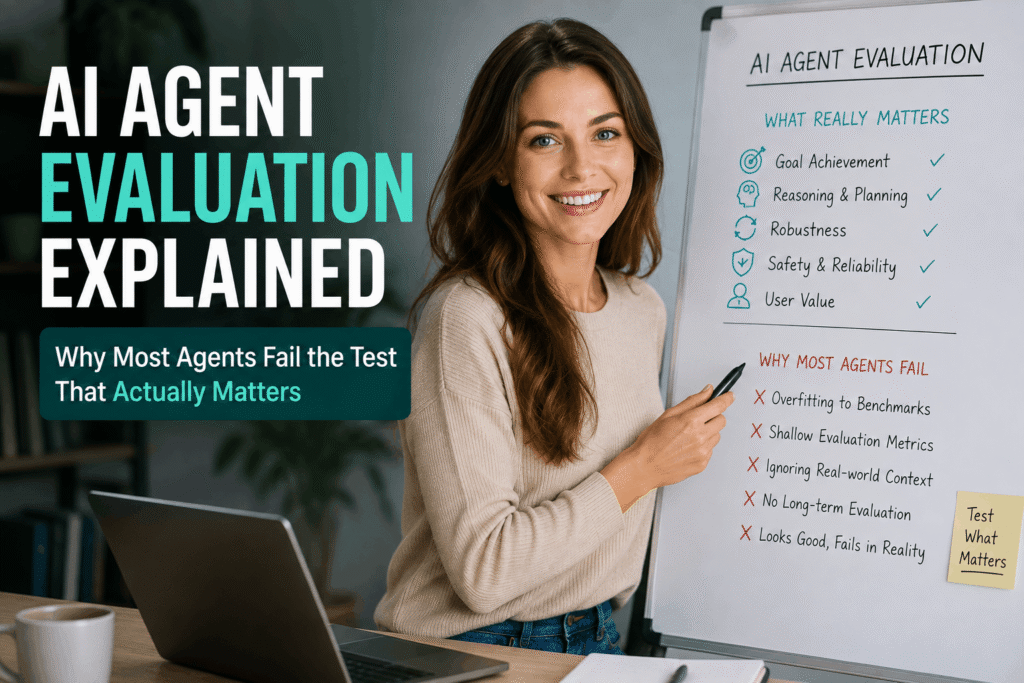

Gartner predicts that over 40% of agentic AI projects will be canceled before the end of 2027. Not because the models got worse. Because nobody could prove the agents actually worked.
That gap between “the demo looked great” and “the agent survived contact with real users” is why AI agent evaluation has become its own discipline. Ask ten teams building agents in 2026 how they know their agent is ready for production, and you’ll get ten different half-answers. Some point to a benchmark leaderboard. Some point to a vibe check from a Slack thread. Almost none of them can show a number that predicts what happens when a real customer, with a real messy request, hits the agent on a Tuesday afternoon.
I’ve spent enough time around applied AI teams to notice the pattern repeat: a pilot performs beautifully in a sandbox, gets greenlit, then quietly falls apart once it meets production traffic. This piece covers what AI agent evaluation actually is, why popular benchmarks tell you less than you think, and a practical framework for testing an agent the way it will actually be used.
AI agent evaluation is the process of measuring whether an autonomous AI system completes multi-step tasks correctly, safely, and efficiently, not just whether its final answer sounds plausible. It works by scoring an agent’s task success rate, the accuracy of the reasoning path (or “trajectory”) it took, its tool-use decisions, and its adherence to policy or safety constraints, usually against benchmarks like GAIA, SWE-bench, and tau-bench, then validated against real production data.
Why Evaluation Became Urgent
Two years ago, “AI agent” mostly meant a chatbot with a few extra tools bolted on. Now it means something that can read your inbox, rewrite a database record, or approve a refund without a human clicking confirm. That shift in autonomy is exactly why evaluation stopped being a nice-to-have QA step.
Gartner attributes much of the coming wave of cancellations to escalating costs, unclear business value, and inadequate risk controls, with analyst Anushree Verma noting that most current agentic AI initiatives are still early pilots shaped more by hype than proven value. Gartner has also estimated that only around 130 of the thousands of vendors marketing “agentic AI” are building something that meets the bar, a pattern it calls agent washing.
Here’s the uncomfortable part. Estimates of how often agents fail once they leave the lab vary wildly, and some AI observability vendors put the figure as high as 70 to 95% under real production conditions. That range is wide enough to be almost useless as a single number, but the direction is consistent: failure happens after launch, not during the demo, and evaluation is the tool that catches it first.
The Benchmark Trap: Why Leaderboards Lie a Little
Most guides tell you to “run the agent against a benchmark” and move on. That advice is incomplete, and it can mislead you.
MMLU, long treated as a headline intelligence measure, is now functionally saturated, with frontier models scoring above 88%. At that ceiling, a two-point gap between models is closer to noise than a real capability difference. Compare that to Humanity’s Last Exam, where even the strongest AI systems land around 35% accuracy while human domain experts average roughly 90%, a 50-plus point gap older benchmarks never revealed.
Agent-specific benchmarks tell a humbling story too. When Sierra introduced tau-bench, built to test whether an agent can hold a realistic customer-service conversation while following the business’s own policy, the best-performing agent at the time achieved under 50% average success across airline and retail domains. Less than half, on tasks human reps handle correctly nearly every time.
Research comparing lab scores to real deployment outcomes has found roughly a 37% gap between controlled evaluation and production performance, with cost variations of up to 50x between agent architectures achieving similar accuracy. Some of that gap comes from flawed benchmarks themselves: audits of popular text-to-SQL evaluation sets have found annotation error rates exceeding 50%, meaning half the “correct” answers an agent is graded against may be wrong.
So what should you take from a benchmark score? Treat it as a floor, not a ceiling. It tells you an agent can complete a narrow task under ideal conditions. It says almost nothing about how that agent handles an ambiguous request or a user who changes their mind mid-conversation, which is exactly what real customers do.
A Practical Framework: Four Layers of Agent Evaluation
Static benchmarks measure one thing: did the agent get the right answer. Production-grade evaluation needs four separate layers, because an agent can pass one and fail badly on another.
- Task success rate. Did the agent accomplish what the user asked? This is where most teams stop, and where most get burned, since a high success rate can hide wasted steps or lucky recoveries from mistakes.
- Trajectory accuracy. Did the agent take a reasonable path to get there? Recent agent research scores goal completion and reasoning trajectory separately, because an agent that stumbles into the right answer through a fragmented process is a liability even when the output looks fine.
- Efficiency and cost. An agent that’s 98% accurate but costs four times as much per task may not be worth deploying. Published evaluations on tau-bench’s airline domain have shown small accuracy differences come with cost gaps exceeding $100 per evaluation run between model choices.
- Policy and safety adherence. Can the agent be talked into breaking a stated business rule? Newer benchmarks, including tau2-bench’s dual-control scenarios, test whether an agent holds the line under pressure from a manipulative user. The NIST AI Risk Management Framework, published in January 2023 and extended for agentic systems since, organizes this kind of measurement under Govern, Map, Measure, and Manage, a useful structure even if you never formally adopt it.
Skip any one of these four layers and you’re evaluating a slice of the agent, not the agent.
Can You Trust an AI to Grade Another AI?
This is the question almost nobody answers honestly: sometimes, but not as often as vendors imply.
Using an LLM as a judge has become the default because human review doesn’t scale, and for general instruction-following tasks it correlates reasonably well with human judgment. The problem shows up in specialized domains. Researchers at Purdue University and the University of Notre Dame compared LLM judges against subject matter experts scoring outputs in dietetics and mental health, two fields where nuance genuinely matters. The subject matter experts and the LLM judges agreed only about 68% of the time, meaning roughly a third of the time an automated grader and a human expert reached different verdicts on the same output.
Their conclusion was to keep humans in the loop for tasks requiring real expertise, not treat LLM-as-judge as a substitute in high-stakes domains. That doesn’t make LLM judges useless. It means the right use case is high-volume, lower-stakes screening, with human review reserved for outputs where getting it wrong actually costs something.
Evaluation Is Also a Governance Problem
Most guides treat evaluation as a purely engineering exercise: run the benchmark, check the score, ship it. That framing misses something. Done properly, evaluation is also how you build the audit trail regulators and your own leadership will eventually ask for.
The EU AI Act’s fuller enforcement lands in August 2026, pushing toward exactly what good evaluation already produces: documented oversight and traceable records of what an autonomous system did and why. There’s a business case too. BCG and Forrester’s 2026 research put median time-to-value on agent deployments at roughly 5.1 months, with narrower use cases like sales agents paying back in as little as 3.4 months. Rigorous evaluation up front is one of the few levers that shortens that timeline, because it catches expensive failures, a policy violation, a runaway tool-calling loop, before they become the incident that gets a project shelved. Not every agent needs this full treatment; a low-stakes internal tool can get by with lighter review, but anything touching money, health data, or customer commitments cannot.
Frequently Asked Questions
What is AI agent evaluation? It’s the practice of testing whether an autonomous AI system completes tasks correctly, efficiently, and safely, across task success, reasoning path, cost, and policy adherence, not just checking one output.
How is evaluating an agent different from evaluating a chatbot? A chatbot check mostly reviews whether one response is accurate. Agent evaluation scores an entire trajectory: which tools got called, in what order, whether the agent recovered from errors, and whether the final action matches what the user actually needed.
Can an AI reliably judge another AI’s output? For general tasks, reasonably well. In specialized domains, a Purdue and Notre Dame study found subject matter experts and LLM judges agreed only 68% of the time, so treat it as a screening tool, not a replacement for expert review in high-stakes areas.
What is trajectory evaluation? It scores the path an agent took, not just whether it succeeded. An agent that reaches the right answer through a messy process is unreliable even when the output looks correct, because that same mess eventually produces a wrong answer.
What is tau-bench? A benchmark from Sierra testing whether an agent can handle realistic customer-service conversations, in retail and airline domains, while following business policy and using real database tools.
How often should a production agent be re-evaluated? Continuously. Models get updated, tool APIs change behavior, and user requests drift. A suite that passed cleanly at launch can start failing silently within months if nobody reruns it against fresh data.
The Bottom Line
Three things stand out. A benchmark score is a floor, not a guarantee, and the gap between lab and production performance is real and documented. Evaluating an agent means scoring four layers, task success, trajectory, cost, and policy, not just whether the final answer looked right. And LLM-as-judge is a useful tool for scale, not a substitute for human review once the stakes get high.
Whether you’re building your first internal agent or trying to figure out why a production deployment keeps misbehaving, AI agent evaluation isn’t a box to check before launch. It’s the ongoing discipline that decides whether your agent becomes one of the projects Gartner counts as canceled, or one that earns its place in the workflow. Start by scoring one production agent you already have against all four layers this week. You’ll probably find a gap you didn’t know was there.