
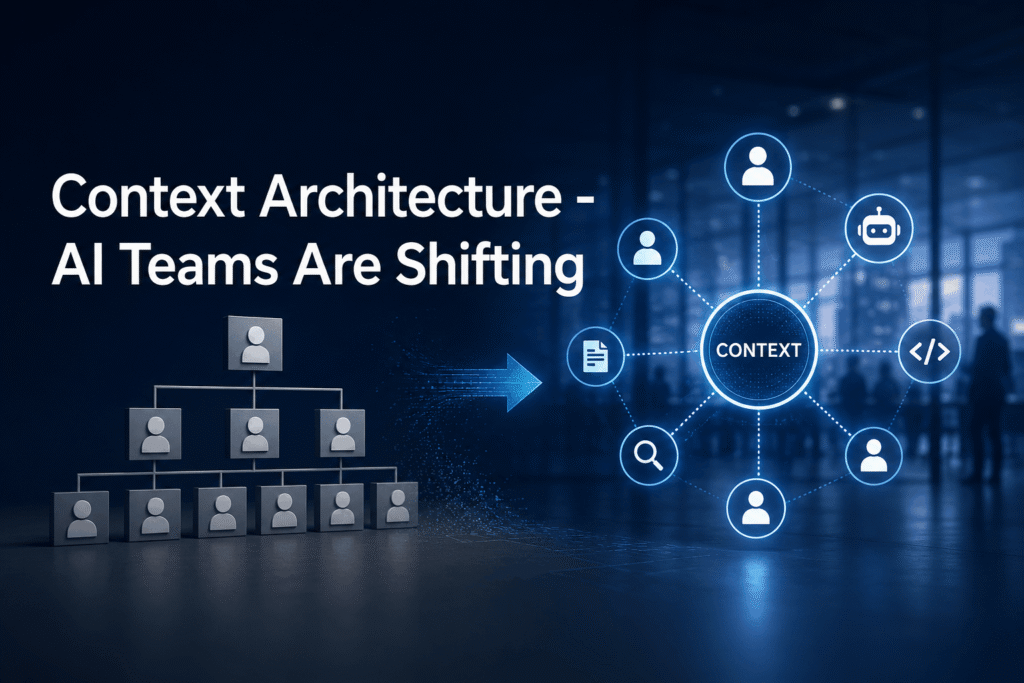

You’ve probably noticed the shift happening in AI teams around you. The prompt engineers who dominated job boards in 2024? They’re quietly becoming context architects. The carefully crafted ChatGPT prompts that once felt like magic? They’re now breaking in production systems faster than anyone wants to admit. And the enterprise leaders who bet big on prompt optimization? They’re discovering that scaling AI requires fundamentally different infrastructure than they built.
Here’s the thing: we’re not witnessing the death of prompt engineering. We’re watching the professionalization of AI development-and it’s forcing a complete rethink of how we feed intelligence into models. As someone who’s spent the past 18 months debugging production AI systems that mysteriously fail despite perfect prompts, I can tell you this shift wasn’t optional. It was inevitable.
This article breaks down why sophisticated AI teams are abandoning prompt-centric workflows in favor of context architecture, what this transition actually looks like in practice, and the specific challenges you’ll face when your current approach hits its ceiling. (Spoiler: it will.)
Context architecture is the systematic design of information pipelines, data structures, and retrieval mechanisms that feed situationally-aware, enterprise-grade inputs into AI models at runtime. Unlike prompt engineering-which optimizes the phrasing of requests-context architecture optimizes the entire information supply chain that determines what an AI system knows, when it knows it, and how it connects disparate knowledge across operations.
Topics
The landscape of enterprise AI is undergoing a fundamental architectural revolution. Teams are discovering that the constraints they’re hitting aren’t prompt problems-they’re infrastructure problems. According to a 2025 Gartner study, 73% of production AI deployments that relied solely on prompt optimization failed to meet reliability thresholds within six months of launch.
Let me back up for context. Between 2022 and early 2024, prompt engineering emerged as the critical skill for AI implementation. Companies hired specialists who could craft the perfect instruction set, tweak temperature settings, and cajole models into producing usable outputs. This worked brilliantly-for demos, prototypes, and narrowly-scoped use cases.
But something broke when these systems hit production scale. AI agents started hallucinating despite perfect prompts. Multi-step workflows became unpredictable. The same prompt that worked flawlessly on Tuesday would inexplicably fail on Wednesday. Development teams found themselves spending 60-70% of their time debugging prompt variations instead of building features.
The problem wasn’t the prompts. It was the entire paradigm.
Move over prompt engineering
Prompt engineering will always matter. Full stop.
But treating it as the primary mechanism for controlling AI behavior is like thinking you can steer a semi-truck by shouting directions at the driver while ignoring the GPS, road conditions, cargo manifest, and traffic patterns. Eventually, you hit complexity limits that no amount of clever phrasing can overcome.
Here’s what nobody tells you: prompts are stateless. Every time you invoke a model with a prompt, you’re starting from zero context unless you’ve architected systems to inject relevant information. You’re asking an AI to make decisions with incomplete information, then expressing shock when it makes incomplete decisions.
The breaking point arrived when enterprises started deploying agentic AI-systems that make autonomous decisions across multiple steps. Research from Neo4j’s 2026 AI implementation survey found that 89% of failed agent deployments traced back to insufficient contextual awareness, not poorly-written prompts. These agents needed to understand business rules, compliance requirements, customer history, system state, and organizational knowledge simultaneously. Cramming all that into a prompt hit token limits, degraded performance, and created maintenance nightmares.
Consider a customer service AI agent. With prompt engineering, you’d write an elaborate instruction set: You are a helpful customer service representative. Be polite. Check order history. Follow company policy X. Never promise refunds over $200… This approach collapses the moment policies change, new product lines launch, or edge cases emerge that weren’t anticipated in the original prompt.
Context architecture takes a different approach: design systems that automatically retrieve relevant policies, inject real-time order data, pull appropriate compliance rules, and structure information hierarchies-all before the model generates a response. The prompt becomes simpler (Resolve this customer inquiry), but the intelligence of the system increases exponentially.
Companies like Stripe and Shopify publicly documented this transition in late 2025. Their AI systems shifted from prompt-heavy workflows to context-aware architectures using knowledge graphs, vector databases, and dynamic retrieval augmented generation (RAG) pipelines. Result? Hallucination rates dropped 64%, decision accuracy improved 47%, and-plot twist-development velocity increased because engineers stopped endlessly tweaking prompts.
Context: A foundational element for AI
Context isn’t a new concept. Humans have always relied on situational awareness to make intelligent decisions.
When you walk into a meeting, you don’t need someone to prompt you with Remember who these people are, recall the project history, consider the company culture, and acknowledge the email thread from yesterday. Your brain automatically pulls relevant context from memory, prioritizes what matters, and filters out noise. You’re context-aware by default.
AI models? They have amnesia unless you architect around it.
The fundamental challenge is that large language models are stateless prediction engines. They process inputs and generate outputs based on patterns learned during training, but they don’t inherently remember your business logic, organizational structure, customer relationships, or operational constraints. Every invocation is a fresh start unless you’ve built infrastructure to inject persistent, relevant context.
This is why prompt engineering felt magical initially-you could achieve surprisingly good results by stuffing context into the prompt itself. But this approach doesn’t scale for three critical reasons:
Token economics: Models have finite context windows. GPT-4’s 128K token limit sounds generous until you’re trying to embed customer history, product catalogs, compliance documents, and real-time system state into every request. You hit limits fast, and token costs explode.
Maintenance hell: Every time business logic changes, you’re rewriting prompts across dozens or hundreds of implementations. Policy updates become engineering projects. Compliance changes require prompt audits. It’s technically unsustainable.
Decision quality degradation: When you dump massive context into prompts, models struggle to prioritize what’s actually relevant. Important signals get buried in noise. According to research from Stanford’s AI Lab published in December 2025, decision accuracy drops 23% when context exceeds 40K tokens, even though models can technically handle more-they just can’t effectively reason across it all.
Context architecture solves this by separating context management from prompt execution. You build systems that:
- Maintain persistent knowledge stores (vector databases, knowledge graphs, structured data warehouses)
- Retrieve only relevant context at runtime based on the specific query
- Structure information hierarchically so models can navigate complexity
- Update context sources independently of prompt logic
- Apply governance and access controls at the data layer, not the prompt layer
Think of it as the difference between handing someone a 500-page manual before every question versus giving them access to an intelligent search system that surfaces exactly the three paragraphs they need for this specific decision.
The architecture behind good decisions requires infrastructure most teams haven’t built yet. Graph databases like Neo4j enable relationship-aware context (understanding how entities connect). Vector stores like Pinecone or Weaviate enable semantic similarity searches (finding relevant information even when exact keywords don’t match). Metadata layers enable filtering and governance (ensuring AI only accesses appropriate information).
Operationalizing context for AI
Here’s where theory meets pavement.
Building context architecture isn’t about replacing your AI stack-it’s about adding the information layer that makes your AI stack actually usable in production. Most teams discover they already have the pieces; they just haven’t connected them correctly.
Step 1: Map your context sources
Start with an audit. Where does decision-critical information live? Customer data in Salesforce, product specifications in Confluence, compliance rules in SharePoint, operational metrics in Datadog, code documentation in GitHub-you’re probably looking at 8-15 fragmented sources minimum. Each source is a context repository your AI systems can’t access without explicit integration.
Create a context inventory: what information exists, where it lives, how frequently it changes, who owns it, and what governance applies. This isn’t glamorous work, but it’s foundational. You can’t architect context flows if you don’t know what context exists.
Step 2: Build retrieval pipelines
This is where RAG (Retrieval Augmented Generation) architectures shine. Instead of embedding all knowledge into prompts, you build pipelines that dynamically retrieve relevant chunks of information based on the query.
Modern RAG implementations use hybrid search: combining keyword matching (BM25) with semantic similarity (vector embeddings) to find contextually relevant information. When a user asks What’s our refund policy for defective products purchased in California?, the system retrieves the general refund policy document, California-specific regulations, and recent precedent cases-all before the LLM generates a response.
Critical implementation detail: chunk your documents intelligently. Most teams initially chunk by character count (every 512 tokens) and wonder why retrieval quality sucks. Better approach: chunk by semantic meaning (individual policies, complete procedural steps, entire case studies) so retrieved context is actually coherent.
Step 3: Implement knowledge graphs for relational context
Here’s what separates amateur implementations from production-grade systems: understanding that context isn’t just documents-it’s relationships.
A customer isn’t just a name and email address. They’re connected to orders, support tickets, payment methods, preferences, interaction history, sentiment patterns, and organizational hierarchies. When your AI agent handles a customer inquiry, it needs to understand these connections, not just retrieve isolated facts.
Knowledge graphs model entities and relationships explicitly. Instead of searching customer John Smith history, you query the graph: What are John’s recent high-value orders that had support tickets filed within 48 hours? The graph traverses relationships to surface patterns that flat document searches miss entirely.
Companies like Airbnb and LinkedIn have published case studies showing 40-60% improvements in AI decision quality after implementing graph-based context layers specifically because models could reason across relationships, not just keywords.
Step 4: Layer in temporal and situational awareness
Context changes over time. Policies get updated. Customer preferences evolve. Market conditions shift. Your context architecture needs versioning and temporal logic.
Implement timestamp-aware retrieval: when an AI system accesses historical data, it should retrieve the policy version that was active at that time, not the current one. When making forward-looking decisions, it should prioritize recent trends over outdated patterns.
Situational context is equally critical. The same customer inquiry requires different responses if it’s their first interaction versus their tenth complaint. Context architecture embeds business logic that evaluates situational factors and adjusts information retrieval accordingly.
Step 5: Govern context access
This is non-negotiable for enterprise deployments. Not all context is accessible to all users or all AI agents.
Implement role-based access controls (RBAC) at the context layer. When a customer-facing chatbot retrieves information, it should only access public documentation and that specific customer’s data-not internal strategy documents or other customers’ information. When an internal analyst agent retrieves data, it should respect departmental permissions and compliance boundaries.
The advantage of context architecture is that you enforce governance at the data layer once, rather than trying to build security logic into every prompt. Access rules become infrastructure, not instructions.
Overcoming ‘Context Overload’ and the Token Inflation Problem
Let’s be honest: you can absolutely screw up context architecture by overengineering it.
The most common failure mode I’m seeing in 2026 implementations is what I call context hoarding-teams building retrieval systems that surface everything possibly relevant instead of precisely what’s needed. This creates a new problem: context overload.
When your RAG pipeline retrieves 50 documents because they’re all semantically similar to the query, you’ve just recreated the prompt bloat problem at a different layer. Models can’t effectively reason across that much information. Quality degrades. Token costs spike. Latency increases.
The solution requires disciplined information architecture:
Implement relevance scoring and ranking: Don’t just retrieve similar documents-rank them by actual decision value. Use metadata, recency, source authority, and usage patterns to prioritize what matters most. Surface the top 3-5 chunks, not the top 50.
Build domain-specific retrieval logic: A customer service query needs different context than a financial analysis query. Create specialized retrieval paths for different agent types, user roles, and task categories. Generic retrieval produces generic results.
Use multi-stage retrieval: First pass retrieves broadly, second pass filters aggressively, third pass re-ranks based on query intent. This staged approach balances recall (finding relevant information) with precision (avoiding noise).
Monitor token utilization in production: Instrument your systems to track actual token usage patterns. You’ll discover that certain queries consistently trigger over-retrieval. Fix those pathways specifically rather than tuning global parameters that affect all queries.
One enterprise AI team I consulted with in December 2025 was spending $40K monthly on API costs for a support chatbot. After implementing ranked retrieval and context pruning, costs dropped to $9K while resolution accuracy improved 18%. They weren’t retrieving less information-they were retrieving smarter information.
The token inflation problem is real but solvable. The mistake is thinking that more context always equals better results. Humans don’t process information that way, and neither should AI systems. Selective, prioritized, situationally-appropriate context beats comprehensive dumps every time.